














The Affiliate-First Launch: How a New D2C Brand Skipped Traditional Influencer Fees Entirely

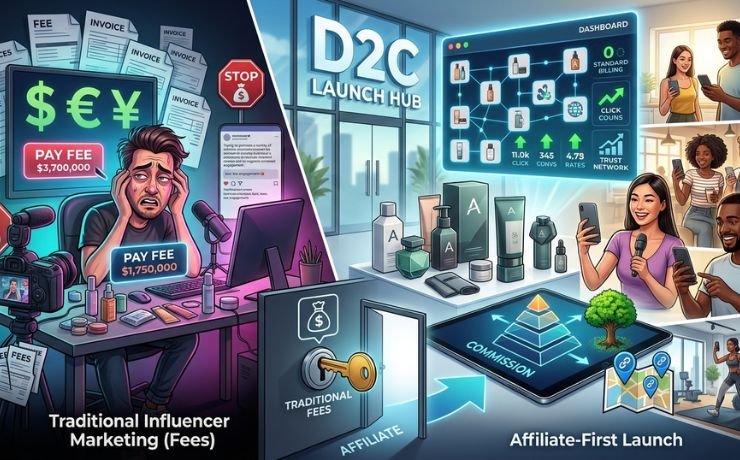
Every few years, a launch strategy comes along that makes the rest of the industry stop and recalculate its own assumptions. For the last several years, the accepted playbook for a new D2C brand entering a crowded category was fairly settled: raise a seed round, ring-fence a chunk of it for a founding influencer roster, pay flat fees to a curated set of creators to manufacture credibility before the product had earned any organically, and hope the resulting buzz converted into repeat customers before the cash ran out. It was expensive, front-loaded, and increasingly unreliable, because audiences had grown adept at spotting a paid-for endorsement the moment it appeared. What’s notable about the newer wave of D2C launches emerging through 2025 and into 2026 is how many of them are quietly abandoning that model altogether — not by cutting influencer marketing, but by restructuring it entirely around commission rather than fees.
The affiliate-first launch isn’t a new concept in principle. Performance marketing has always had an affiliate layer sitting somewhere in the funnel. What’s changed is its position in the strategy — moving from a supplementary channel bolted onto a paid-fee influencer campaign, to the primary, and in some cases only, mechanism through which a brand builds its early creator relationships. No upfront fees. No guaranteed posts. No negotiated flat rates for a fixed number of Reels. Instead: a product, a commission structure, and an open invitation to any creator willing to promote it on the understanding that they only get paid when it actually sells.
Why this suddenly makes sense now
Three things have converged to make this model viable at launch stage in a way it simply wasn’t a few years ago. The first is infrastructure. Affiliate tracking, attribution and payout technology has matured to the point where a small D2C team, sometimes just a founder and one marketing hire, can set up a functioning affiliate programme in days rather than months, using off-the-shelf platforms that handle unique tracking links, real-time commission calculation and automated payouts without requiring an in-house engineering build. What used to require a dedicated affiliate operations function is now something a lean team can run alongside everything else.
The second is social commerce infrastructure specifically built for creators — shoppable links, in-app checkout, live commerce formats — which has shortened the distance between a creator’s content and an actual purchase to almost nothing. A viewer no longer has to leave the platform, search for the brand, and complete a multi-step checkout. They can transact within the same scroll. This compression of the funnel is precisely what makes commission-based creator economics work: the shorter and more trackable the path from content to conversion, the more confidently a brand can attribute a sale to a specific creator and pay them fairly for it.
The third, and arguably most important, factor is capital discipline. The funding environment for new D2C brands has tightened meaningfully compared to the exuberant years of 2020 to 2022. Founders raising seed and pre-seed rounds today are being pushed by investors to demonstrate capital efficiency almost from day one, and a marketing model where spend is directly proportional to revenue generated is, on paper, about as capital-efficient as it gets. Paying a flat fee to a creator with no guarantee of sales is, from this lens, simply a worse bet than paying a commission only when the sale actually happens.
What the model actually looks like in practice
A typical affiliate-first launch doesn’t look like a traditional influencer campaign at all in its early weeks. There’s no carefully curated list of ten mid-tier creators receiving briefs and product kits under embargo. Instead, brands are opening affiliate programmes broadly — sometimes publicly, through creator marketplaces and affiliate networks, sometimes through direct outreach to a wider, more diverse pool of nano and micro creators who wouldn’t have made the cut, or the budget, of a traditional fee-based campaign. Commission rates typically run higher than what a creator might earn per-post under a flat-fee arrangement, precisely to compensate for the risk being shifted onto them — the creator is essentially betting their time and content-making effort on the product converting.
What emerges from this is a much larger, messier, but ultimately more organic-looking wave of content. Instead of ten polished, brand-briefed posts appearing within the same week, a brand might see fifty or a hundred creators posting over a period of months, each testing the product in their own voice because they have genuine financial incentive to make content that actually converts, rather than content that simply satisfies a brief. Paradoxically, removing the flat fee and the formal brief often produces content that reads as more authentic, precisely because the creator’s incentives are now aligned with genuine persuasion rather than contractual compliance.
The trade-offs nobody advertises
This model is not without real costs, and it would be misleading to present it as a costless upgrade on traditional influencer spending. The most obvious trade-off is control. A brand running an open affiliate programme has far less say over what gets said about the product, in what tone, alongside what other content, and by whom. There is no brief enforcing brand safety, no pre-approval process, no guarantee that the creators who join the programme reflect the audience or aesthetic the brand actually wants to be associated with. For categories where brand perception is fragile or where regulatory sensitivity is high — skincare, wellness, anything health-adjacent — this loss of control carries real risk, and it’s notable that affiliate-first launches have concentrated most heavily in categories like fashion, accessories, home and lifestyle, where the downside of an off-brand post is lower.
The second trade-off is predictability. A flat-fee campaign, however expensive, at least guarantees a known quantity of content on a known timeline. An affiliate programme’s output is inherently unpredictable — a brand cannot promise a founder or an investor that a certain volume of content will appear by a certain date, because it depends entirely on whether creators choose to participate and whether their early content performs well enough to motivate more. This makes affiliate-first launches poorly suited to brands that need a coordinated, big-bang launch moment — a product drop tied to a specific date, a festive season push, a moment that needs guaranteed, synchronised visibility. It suits brands with the patience to build momentum gradually far better than it suits brands chasing a single high-stakes launch week.
There’s also a quieter risk around creator quality and fraud that affiliate marketing has always had to manage. Commission-only structures can attract creators optimising purely for clicks and short-term conversion rather than genuine audience fit, and without careful vetting, a brand can end up with a roster of low-quality affiliates generating technically trackable but commercially hollow activity. The platforms and networks facilitating these programmes have gotten considerably better at fraud detection and engagement quality scoring, but this remains an area requiring active management rather than a set-and-forget assumption.
What this signals about where creator economics are heading
The broader significance of the affiliate-first launch isn’t really about any single brand’s clever workaround for a limited budget. It’s a signal of where the underlying economics of the creator economy appear to be heading more generally — toward a market where compensation is tied more directly to demonstrated outcome, and less to reach or follower count as a proxy for value. For years, influencer marketing pricing has been criticised, not unfairly, for being anchored to metrics that correlate poorly with actual sales impact. A creator with a large, engaged, but purely aspirational following can command a high flat fee while converting almost nothing, while a smaller creator with a highly commercial, purchase-ready audience might be dramatically underpriced by the same follower-based logic. Commission-based models sidestep this mispricing entirely by paying for the thing brands actually want, which is sales, rather than the thing that’s historically been easiest to measure, which is audience size.
This doesn’t mean flat-fee influencer marketing is disappearing, and it would be a mistake to read the affiliate-first launch as evidence that the traditional model is obsolete. Brand-building activity — the kind of top-of-funnel work that builds awareness and cultural relevance rather than driving an immediate transaction — is genuinely difficult to achieve through commission structures alone, because a creator has little incentive to produce purely awareness-building content when their pay depends entirely on a click converting. What seems more likely is a bifurcation: flat fees persisting for brand-building, top-tier creator partnerships where the goal is cultural association rather than direct response, and commission-based, affiliate-first structures increasingly dominating performance-oriented, lower-funnel activity, particularly for younger, capital-constrained brands that cannot afford to bet marketing spend on reach they can’t yet prove will convert.
A test of nerve as much as a test of strategy
For founders considering this path, the honest appeal of the affiliate-first model isn’t just that it’s cheaper, though it usually is. It’s that it forces genuine discipline around product-market fit early in a brand’s life. A product that doesn’t convert well simply won’t attract sustained creator participation under a commission model — there’s no fee cushioning a weak product’s poor performance, no vanity metric to hide behind. In that sense, an affiliate-first launch functions almost as an ongoing, real-time referendum on whether the product actually works for the audience being targeted, which is a more honest signal than a curated influencer campaign has typically provided.
Whether this becomes a durable structural shift in how D2C brands launch, or simply a pragmatic adaptation to a tighter funding environment that reverses once capital loosens again, remains to be seen. But for now, it represents one of the more interesting experiments in aligning creator and brand incentives that the industry has produced in some time — and a reminder that the most disruptive ideas in marketing are often not new channels, but old channels restructured around who bears the risk.
