














50 Million and Counting: What India’s CTV User Base Milestone Means for Ad Inventory

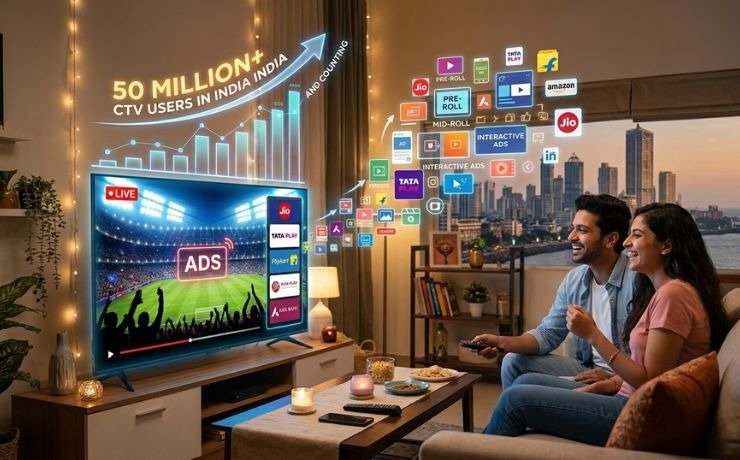
A media planner sitting down to build a 2026 plan two years ago would have given Connected TV a polite nod and moved on. The audience was too thin to anchor a national campaign, the measurement too murky to defend in a post-campaign review, and the inventory too scattered across devices and apps to buy with any real confidence. That planner would not recognise the category today. India’s CTV user base has now crossed 50 million, and depending on which research house is doing the counting, the broader monthly Connected TV audience is already well beyond that — Kantar’s latest Media Compass report puts it at 166 million viewers in Q1 2026, up 23% year on year, with 36% of that base, roughly 59 million people, watching exclusively on connected devices and never touching linear television at all. The screen has scale now. What the industry is still working out is what that scale actually does to the inventory sitting behind it.
The numbers, at a glance:
50–60 million CTV households expected by mid-2026, growing ~21% year on year
166 million monthly CTV viewers as of Q1 2026 (Kantar), up 23% YoY
CTV ad spend projected between ₹3,000 crore and ₹8,000 crore for 2026, depending on methodology
Nearly half of advertisers globally now expect CTV inventory to trade programmatically
Up to 50% of unverified CTV impressions may be non-viewable without proper checks
Why the range is so wide. The gap between a ₹3,000 crore estimate and one closer to ₹8,000 crore is not really a disagreement about direction — every forecaster agrees the curve is steep and compounding. It is a disagreement about definition. Some trackers count only in-app OTT video inventory; others fold in OEM home-screen advertising, ACR-based targeting units, and hybrid mobile-television crossover spend. India’s CTV market has grown fast enough that measurement frameworks have not yet caught up to give the industry one shared number, which is itself a useful signal: this is still a young enough category that its own accounting is being built in real time, alongside the audience.
What scale actually buys advertisers. Once a channel clears roughly 50 million users, it stops being a test-budget curiosity and becomes something a brand can build real reach against. Indian viewers now spend upward of 3.5 hours a day with television-style content, and a growing share of that time carries no linear fallback at all — it is CTV or nothing. That combination is why brands that spent the last two years treating Connected TV as an interesting line inside a broader digital budget are now carving out a dedicated allocation for it, sitting alongside television and social rather than buried inside “digital video” as an afterthought.
What scale does not fix. More eyeballs means more parties competing to sell access to them, and Indian CTV inventory currently runs through one of the messier ownership structures anywhere in global streaming. Every impression passes through at least two layers: the OEM layer — the smart TV’s own operating system, home-screen advertising and ACR-based targeting — and the OTT layer, where individual apps like JioHotstar, YouTube and SonyLIV sell their own in-content inventory directly. A single household might run a Samsung or Xiaomi TV operating system with YouTube installed natively and a JioHotstar app layered on top, and each surface sits inside its own separate auction, its own frequency-capping rules, and its own reporting standard. For a planner trying to build one coherent reach-and-frequency model across a campaign, that is less a data problem than a manual reconciliation project.
Where the value is concentrating. Nowhere is the ownership contest more visible than around live sport, and nowhere is inventory value more lopsided. During the early rounds of IPL 2026, JioHotstar alone accounted for the largest share of connected TV ad volumes in the country by a wide margin — comfortably ahead of every other platform and OEM pool combined. That is the entire logic of Indian CTV inventory in one data point: live sport delivers sustained, unskippable attention from audiences already primed for a big-screen occasion, and that commands a premium no generic home-screen banner can match. The 2025 merger of Disney+ Hotstar and JioCinema into JioHotstar, now claiming more than 500 million monthly users and holding exclusive rights across the IPL, ICC tournaments, the ISL and the Premier League, assembled the single largest pool of premium video inventory ever consolidated under one Indian ad-sales roof. Everything else — YouTube CTV, Amazon Fire TV, OEM home-screen units, regional OTT apps — fills out a considerably longer, more fragmented tail.
How buyers are actually navigating it. Fragmentation is precisely why programmatic buying has become the default entry point rather than a nice-to-have. Close to half of advertisers globally now expect CTV inventory to be transactable programmatically, and Indian platforms are following the same arc — JioHotstar has moved most of its own inventory onto Programmatic Guaranteed and Private Marketplace deals, giving buyers more transparent, data-backed access instead of negotiated upfront-only commitments. For a mid-sized brand without the scale to go direct to a platform’s ad-sales desk, a demand-side platform with access to Indian streaming inventory is now the sensible on-ramp: start with a modest test budget, optimise against completion rate and incremental reach rather than last-click conversion, and treat the spend as upper-funnel brand investment first.
The shoppable experiment. Platforms are also working to extract more value from the same inventory pool rather than simply selling more of it. JioHotstar’s shoppable carousels let brands parade product rows across the screen for what the platform calls “product discovery” — closer to window shopping than checkout. A newer “send to phone” format, tested abroad on Amazon’s Prime Video inventory, skips the on-screen transaction entirely and fires a product link to the viewer’s mobile number, letting the second screen close the loop. The pattern holds across nearly every shoppable format live in India today: the big screen sets the stage, the phone does the actual selling backstage. The sensible way to evaluate these formats in 2026 is as an engagement and consideration layer first, and a direct-response channel a distant second — the measurement infrastructure genuinely cannot support more than that yet.
The trust gap nobody is advertising. Verification partners flag that as much as half of raw CTV impressions can be non-viewable without proper checks in place, a meaningful risk given how much premium pricing rides on guaranteed, brand-safe, fully-in-view delivery. OEM platforms leaning on Automatic Content Recognition offer one path to cleaner measurement, but ACR data quality and coverage still vary by manufacturer, which means a buyer running an OEM-plus-OTT plan is often working with two different confidence levels inside the same campaign. This is the quieter counterpart to the 50-million milestone: audience size has outpaced the industry’s collective ability to verify, standardise and price that audience with full confidence — and closing that gap may matter more to CTV’s next phase than the user count itself.
What this means for anyone planning spend now. Three things worth internalising. CTV inventory in India is not one market but several, layered on top of each other with different economics and different scarcity — treating a JioHotstar IPL package and a long-tail OEM home-screen placement as interchangeable “CTV spend” is already a planning error. The entry cost for testing the channel has genuinely come down even as the entry cost for premium inventory has gone up, since programmatic access no longer requires a direct platform relationship, though the very best inventory still does. And the window for treating CTV as cheap incremental reach is closing — inventory around live sport and festive-season content will get more expensive from here, not less, and brands that build genuinely television-quality creative now, rather than repurposing a mobile pre-roll for a 55-inch screen, are the ones positioned to make the next leg of growth pay off rather than simply pay for.
Fifty million was never going to be a ceiling; the market has already moved past it in raw viewership terms. What the milestone signals is a shift in seriousness — the point where CTV stops being an experimental line inside a digital budget and becomes contested, premium, increasingly programmatic real estate, with platforms, OEMs and advertisers all racing to set the rules before the rules get set for them. The audience is unmistakably there. What is still being built, somewhat messily and in real time, is the infrastructure of trust that decides how much of that audience’s value actually reaches the brands paying for it.
