














Programmatic Now 42% of India’s Digital Spend — What’s Driving the Next Leg of Growth

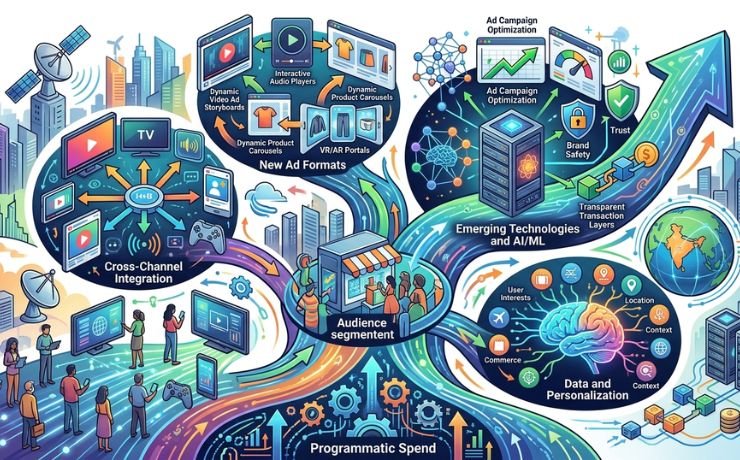
There was a time, not very long ago, when programmatic advertising in India was still spoken of as the future tense. Agencies ran pilot campaigns alongside their direct-sold buys, clients asked cautious questions about brand safety and transparency, and the entire conversation carried the slightly defensive energy of a technology still proving itself. That conversation is over. Programmatic buying now accounts for 42 percent of India’s digital ad spend, and depending on which industry tracker you consult, that share is already nudging past 44 percent as 2026 plays out. This isn’t an emerging channel anymore. It is the operating system of Indian digital advertising, and the interesting question is no longer whether programmatic has arrived, but what happens now that it has effectively become the default.
The scale here deserves a moment of context. India’s overall digital advertising market crossed roughly ₹94,700 crore in 2025, growing 26 percent year on year, and programmatic’s share of that pool translates into tens of thousands of crores flowing through automated, real-time bidding systems rather than negotiated insertion orders. Industry estimates put programmatic spend on a trajectory toward roughly ₹30,000 crore by 2026, growing at a compound annual rate north of 21 percent, comfortably outpacing the growth of digital advertising as a whole. When a sub-channel grows faster than its parent category for this many consecutive years, it stops being a sub-channel. It becomes the category’s centre of gravity.
Why fragmentation became programmatic’s best friend
The single biggest force behind programmatic’s rise in India isn’t a piece of technology at all. It’s the sheer fragmentation of where Indian audiences actually spend their time. As Zenith India’s CEO Jai Lala has put it, when you look at the consumer journey and the fragmentation happening across it, programmatic becomes the thing that stitches those pieces back together, effectively becoming the backbone from which a fragmented journey can be linked into a single, coherent campaign. That’s not marketing language; it’s a fairly literal description of what programmatic infrastructure does. A single urban Indian consumer today might scroll Instagram over breakfast, stream a cricket match on a Connected TV in the evening, listen to a podcast on the commute, and browse a quick commerce app before bed. No single publisher relationship, however strong, can follow that consumer across all four moments. Programmatic, by design, can.
This fragmentation is compounding rather than stabilising, and that’s precisely why programmatic’s share keeps climbing instead of plateauing. Connected TV inventory, OEM-level ad placements, retail media networks, in-app inventory across a proliferating universe of vernacular and category-specific apps, audio platforms, and out-of-home digital screens are all adding new addressable surfaces to the media landscape faster than traditional, relationship-based direct buying can absorb them. Every new surface is, almost by default, sold programmatically first, because building a dedicated direct sales relationship for every individual publisher simply doesn’t scale the way an automated marketplace does.
The retail media effect
If there’s one force multiplier behind programmatic’s next leg of growth specifically, it’s retail media, and the connection between the two is closer than most marketing conversations acknowledge. Retail media spend in India is expanding at roughly 22 percent this year, comfortably outpacing the growth rates of both paid search and paid social, driven substantially by the boom in quick commerce. Every major e-commerce and quick commerce platform in India is now, in effect, also an advertising platform, monetising the first-party purchase-intent data it collects on millions of shoppers.
What makes this relevant to programmatic specifically is how that inventory gets transacted. Retail media networks overwhelmingly sell their advertising placements through programmatic pipes, real-time bidding and programmatic guaranteed deals, because that’s the only mechanism that can efficiently match the granularity of first-party shopping data with the scale of impressions these platforms generate every second. As e-commerce advertising surged an estimated 50 percent through 2025, it effectively became one of programmatic’s largest new demand engines. This is a genuinely symbiotic relationship: retail media needs programmatic infrastructure to monetise its data at scale, and programmatic needs retail media’s first-party signal to stay valuable in a cookie-constrained world.
Programmatic didn’t just survive the end of third-party cookies in India. It found its most valuable new data partner in the checkout cart.
Regulation as an accelerant, not a brake
It’s worth pausing on a genuine irony in this growth story: privacy regulation, which many in the industry initially feared would slow programmatic down, has in practice become one of its accelerants. India’s Digital Personal Data Protection Act established clear new obligations around consent, data storage, and cross-border data transfers, and the natural assumption when such frameworks arrive is that they constrain data-driven advertising. What has actually happened in India mirrors a pattern seen in other regulated markets: as third-party data and cookie-based targeting come under tighter scrutiny, first-party data, the kind retail media networks, telecom operators, and large publisher ecosystems hold directly, becomes dramatically more valuable. Programmatic infrastructure, built from the ground up to activate data at the point of transaction, is precisely the mechanism best suited to monetise that first-party data responsibly and at scale. Regulation didn’t shrink the addressable pie for programmatic; it redirected demand toward the parts of the ecosystem programmatic already dominated.
CTV and OEM inventory: the newest frontier
Connected television deserves specific mention as a growth driver, not merely because it’s fashionable to discuss, but because of how directly it has expanded programmatic’s addressable inventory. Weekly active CTV homes in India have grown substantially over the past year, and as Frodoh’s founder and CEO Russhabh Thakkar has noted, it isn’t only traditional digital spaces like OTT and video driving this expansion; OEMs and CTV platforms themselves have added meaningful diversity to the available ad inventory pool. Smart TV home screens, app launcher placements, and OEM-level advertising units are all new surfaces that essentially didn’t exist as programmatic inventory three years ago, and nearly all of them are being sold through automated, real-time channels rather than negotiated directly, simply because the publisher landscape is too fragmented and the inventory too abundant for direct sales teams to cover manually.
This matters because CTV and OEM inventory bring something programmatic has historically lacked in India: premium, brand-safe, large-screen placements that command strong rates and appeal to the same brand-building advertisers who have traditionally been the most cautious about automated buying. As this inventory category matures and measurement standards around it improve, expect it to pull an increasing share of upper-funnel, brand-oriented budgets into programmatic pipes that were previously reserved for negotiated linear television or premium direct-sold digital placements.
The efficiency argument still does most of the heavy lifting
For all the sophisticated structural explanations, it would be a mistake to overlook the plainer, more practical reasons advertisers keep choosing programmatic: it works, and it’s demonstrably efficient. Techmagnate’s founder and CEO Sarvesh Bagla frames programmatic’s advantage in India around three straightforward pillars: precision in targeting the right audience, real-time adaptability based on live consumer data, and cost-effectiveness relative to traditional, negotiated ad formats. None of these are new arguments, but their cumulative effect compounds every year that Indian marketing teams get more comfortable reading programmatic dashboards and trusting automated bidding logic over manual negotiation. Every campaign cycle that proves out programmatic’s efficiency claims makes the next budget conversation easier, and every marketer who moves from a performance role into a CMO seat brings that comfort with automated buying upward with them.
The concentration problem hiding inside the growth story
No honest account of programmatic’s rise in India can skip past an uncomfortable structural fact: a huge share of this growth is still flowing through, or at least gated by, a very small number of global platforms. Search and social media platforms, led overwhelmingly by Google and Meta, captured roughly 64 percent of India’s total digital advertising revenue in 2025, and much of that concentration is itself transacted through programmatic mechanisms, auction-based social feed placements and programmatic search inventory that sit within walled gardens rather than the open, cross-publisher exchanges programmatic was originally conceived to enable.
This creates a genuine tension for the industry to watch closely. On one hand, programmatic’s headline growth numbers look uniformly positive. On the other, a meaningful share of that growth represents deepening dependence on two platforms whose algorithms, pricing, and data policies Indian advertisers and publishers don’t control. The next leg of programmatic’s growth story in India will be shaped substantially by whether open-exchange programmatic, the CTV, retail media, and OEM inventory genuinely available for competitive bidding across multiple demand-side platforms, can grow its share relative to walled-garden auction spend, or whether “programmatic growth” simply becomes a more technical way of describing continued Google and Meta dominance.
Where the next leg actually comes from
Put the pieces together and a fairly clear picture of programmatic’s next growth phase in India emerges. Retail media and quick commerce will keep supplying fresh first-party data and expanding inventory faster than almost any other category. CTV and OEM surfaces will keep opening premium, brand-safe placements that pull upper-funnel budgets into automated buying. Regulatory pressure on third-party data will continue, counterintuitively, to reward the platforms and networks with strong first-party data assets, most of which transact programmatically. And a maturing generation of Indian marketers, increasingly comfortable with real-time, data-driven campaign management, will keep shrinking whatever residual preference for manual, negotiated buying remains.
The 42 percent figure, in other words, isn’t a ceiling. It’s closer to a base camp. The infrastructure, the inventory, and the institutional comfort are all still expanding, and every structural force currently in motion, from quick commerce to CTV to data regulation, happens to point programmatic’s way. The industry’s more interesting question over the next few years won’t be how high programmatic’s share of digital spend climbs. It will be whether that growth broadens the ecosystem, pulling more publishers, more inventory types, and more competitive demand into genuinely open programmatic marketplaces, or whether it simply becomes a more precise description of how thoroughly two global platforms have come to define Indian digital advertising.
