














Smart TV Shipments Cross 10 Million — Why Ad Inventory Is Outpacing Ad Demand

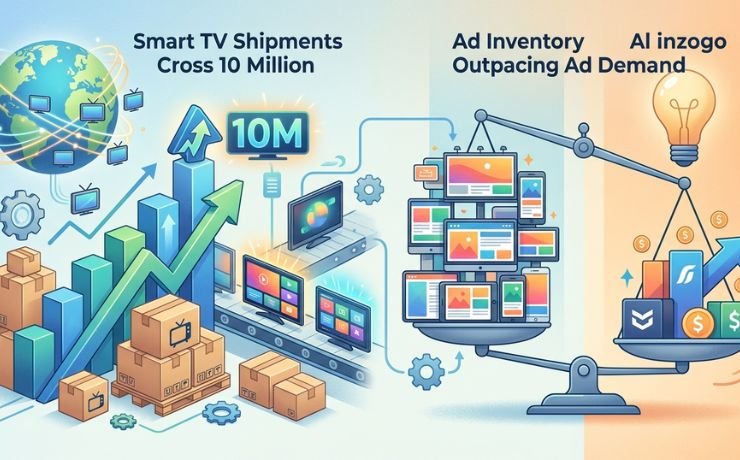
Somewhere in the last eighteen months, the Indian living room quietly changed shape. The remote got smarter, the screen got bigger, and the television, once the most passive box in the house, turned into the most data-rich one. Smart TV shipments in India have now crossed the 10 million mark for the year, according to industry tracking data, a milestone that would have seemed improbable even three years ago when Smart TVs were still a premium, urban, aspirational purchase rather than a default one.
On paper, this looks like unambiguous good news for anyone selling advertising against connected screens. More Smart TVs means more Connected TV households, more addressable inventory, more targeting precision, more of everything that has made CTV the most talked-about acronym in Indian media planning decks since programmatic itself. And yet, spend a few weeks talking to the people who actually buy and sell this inventory, and a more complicated picture emerges. Supply is sprinting. Demand is jogging. And the gap between the two is starting to show up in yields, in fill rates, and in the kind of quiet frustration that doesn’t always make it into the press release.
The arithmetic of abundance
To understand why inventory is outrunning demand, it helps to look at what has actually driven the shipment numbers. This isn’t a story of a single breakout brand or a single festive season sale event. It’s a structural shift. Panel prices have fallen steadily as manufacturing has scaled, homegrown and Chinese-origin brands have pushed aggressively into the sub-20,000-rupee segment, and telecom and broadband bundling has made a Smart TV feel less like a discretionary electronics purchase and more like an extension of the home internet connection. Add to that the steady march of set-top box replacement cycles, where cable and DTH households are migrating to hybrid or pure Smart TV setups, and you get a market where screens are multiplying faster than any single advertiser’s media plan can absorb.
Every one of those new screens is, by default, an ad opportunity. Home screens carry sponsored tiles. App launchers carry pre-roll. Free ad-supported streaming television, or FAST channels, have exploded precisely because they monetise idle screen time that would otherwise generate nothing. Multiply lakhs of new households by dozens of daily impressions each, and the resulting inventory pool is genuinely enormous. The problem is that “enormous” and “valuable” are not the same word, and the CTV ecosystem in India is currently discovering the distance between them.
Why buyers haven’t kept pace
Ad demand doesn’t scale the way hardware does. A television set can be manufactured, boxed, and shipped in weeks. A brand’s willingness to shift budget from a channel it understands, television or digital video, into one it is still learning to measure takes considerably longer. That lag is the real story behind the inventory glut.
Three specific frictions keep coming up in conversations with media buyers. The first is measurement fragmentation. Unlike linear television, where BARC has long provided a single, if imperfect, currency that the entire industry can plan and buy against, CTV in India still lacks a unified measurement standard that commands universal trust. Different platforms report reach, frequency, and completion rates using different methodologies, and marketers who are used to comparing apples to apples on linear GRPs are understandably reluctant to commit large budgets to a channel where the fruit basket keeps changing shape.
The second friction is planning inertia. Television buying in India still runs largely through agency desks structured around linear inventory, upfront commitments, and long-standing rate cards. CTV, by contrast, is transacted programmatically, in real time, often through a patchwork of demand-side platforms, walled gardens, and direct deals with individual OEMs and streaming apps. For a brand’s media team, folding CTV into an existing linear-first plan requires new workflows, new vendor relationships, and often, new internal expertise. That’s a slower organisational shift than simply switching which network gets a bigger share of an existing television budget.
The third, and perhaps most understated, friction is regional and tier-two reach. Much of the recent surge in Smart TV shipments has come precisely from smaller towns and price-sensitive households, the same audience that regional-language content and vernacular advertising are built for. But a meaningful share of premium CTV ad demand is still concentrated among metro-first, English-language, brand-safety-conscious advertisers who are cautious about where exactly their pre-roll is landing on a fragmented FAST channel ecosystem. The audience has arrived ahead of the advertiser’s comfort level with that audience.
The screen count solved itself faster than the trust problem did. That’s really the whole story of CTV in India right now.
What an oversupplied market actually looks like
In practical terms, the demand-supply mismatch shows up in three places. Fill rates on FAST channels and ad-supported streaming apps have softened in several categories outside the festive and sports-heavy quarters, forcing publishers to lean harder on remnant inventory deals, house ads, and programmatic guaranteed packages sold at compressed CPMs simply to keep sell-through respectable. eCPMs on CTV inventory, which had commanded a premium over mobile and desktop video on the promise of the “biggest screen in the house,” have in several segments come under quiet pressure as sellers compete for a demand pool that hasn’t grown at the same clip as the inventory itself.
There’s also a subtler consequence: inventory quality dispersion. When supply outstrips demand, the inventory that clears easily tends to be the premium, well-measured, brand-safe placements, typically on the larger OEM platforms and established streaming apps, while a long tail of smaller FAST channels and app launchers struggles to find buyers at any meaningful price. This is creating a two-speed CTV market within India: a thin top layer that behaves like a seller’s market, commanding strong rates from performance and brand advertisers alike, and a much wider base that behaves like a genuine buyer’s market, where publishers are essentially competing on price for whatever demand trickles down.
For media planners, that bifurcation is actually useful information, if they know to look for it. It means the conversation with clients shouldn’t be “should we buy CTV,” a question that treats the channel as monolithic, but “which layer of CTV inventory fits this specific campaign’s objectives and measurement tolerance.” Performance-oriented, lower-funnel campaigns with flexible creative and a higher appetite for measurement ambiguity may find genuine value, and negotiating leverage, in the oversupplied long tail. Brand-building campaigns that need certainty around context and completion rates are better served paying the premium for the thinner, better-measured top layer, at least until the broader ecosystem catches up on standardisation.
The path to closing the gap
None of this means CTV demand in India is stalling; if anything, most forecasts still point to steady year-on-year growth in CTV ad spend. The issue is one of pace, not direction. And there are early signs that the pace is starting to pick up.
Measurement is the most consequential lever. Industry bodies and ratings agencies have been working, in fits and starts, toward CTV measurement frameworks that could eventually sit alongside or integrate with existing linear currencies. Even incremental progress here, a widely accepted reach and frequency standard, or a credible cross-platform de-duplication methodology, would remove one of the biggest psychological barriers keeping conservative brand budgets on the sidelines. Advertisers don’t necessarily need perfect measurement to commit; they need measurement they can defend in a boardroom.
OEM and platform consolidation is another quiet accelerant. As Smart TV operating systems and major streaming aggregators build out their own ad tech stacks, the buying experience for CTV inventory is starting to resemble the walled-garden simplicity that has made platforms like Meta and Google easy to transact on at scale. Fewer, deeper integration points make it easier for agencies to justify the workflow investment CTV currently demands.
Finally, and perhaps most importantly for a market where this article’s own headline milestone originates, the continued proliferation of Smart TVs into tier-two and tier-three India is itself going to force demand to follow, eventually. Regional and vernacular-first brands, quick commerce players, and D2C advertisers who have already built performance-marketing muscle on mobile are natural early movers into this inventory, precisely because they’re less encumbered by the linear-television planning habits that are slowing down larger, more traditional advertisers. Watch this cohort closely over the next few quarters; they are likely to be the ones who arbitrage the current oversupply before the broader market catches up and the pricing gap closes.
The 10 million shipment milestone, in that sense, isn’t really the end of a story. It’s the moment the CTV opportunity in India stopped being theoretical and started being a genuine capacity problem, supply that has outpaced the industry’s own readiness to buy it intelligently. Whoever solves that readiness problem first, whether through measurement, platform consolidation, or simply braver early budgets, stands to buy some of the best-priced inventory this channel will ever offer.
