














Interactive CTV Formats — Pause Ads, QR Codes and the New Grammar of TV Advertising

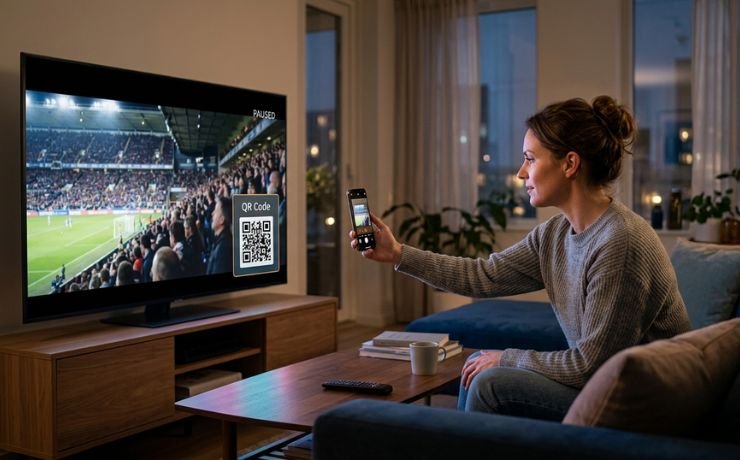
Somewhere between the third episode of a weekend binge and the fourth cup of chai, a viewer in Pune pauses her show to answer a phone call. For three, four, maybe ten seconds, her television screen freezes on a single frame. A decade ago, that frame would have been wasted real estate — a blurry still of a paused sitcom, functionally invisible. Today, it might carry a skincare brand’s product shot, a discount code, or a QR code inviting her to shop the exact serum her favourite character just used. She may never notice it consciously. But somewhere in an advertiser’s dashboard, that pause has been logged, priced, and sold.
This is the quiet, unglamorous frontier of Connected TV advertising in India — not the splashy, cinematic pre-roll spots that dominate award-show reels, but the granular, interaction-native formats that are rewriting what it means to advertise on the big screen. Pause ads, QR overlays, shoppable frames, interactive polls layered onto live sport — these are not experiments anymore. They are becoming the default grammar of a medium that spent its first few years simply imitating linear television and is only now beginning to speak its own language.
The screen that finally listens back
For the better part of a century, television advertising operated on a single, unforgiving assumption: the viewer is watching, and the ad will be seen because there is no alternative. CTV dismantles that assumption entirely. Every stream is app-based, every remote has a pause button, and every platform — from Amazon miniTV to JioHotstar to the increasingly ad-supported tiers of global streamers — logs viewer behaviour with a granularity linear broadcasters could never dream of. The result is an inversion of the old model. Instead of designing ads to survive inattention, CTV planners are now designing ads to exploit the moments when attention is guaranteed by definition — the pause, the search, the second-screen glance at a phone.
A pause ad is deceptively simple in concept: when a viewer pauses content, the streaming interface swaps the frozen frame for a branded overlay, often static, sometimes with a QR code or a short call to action. What makes it powerful is not the creative sophistication — pause ads are, by necessity, minimal — but the context. A viewer who has actively chosen to pause is, almost by definition, not skipping or scrolling past. They are present. In an attention economy where the median video ad view length on mobile has been shrinking for years, presence has become the scarcest currency in media buying, and pause inventory sells at a premium precisely because it is guaranteed rather than probabilistic.
QR codes, for their part, have completed one of the more improbable comebacks in marketing history. Written off after their over-hyped, under-adopted debut in the early 2010s, they were resurrected almost single-handedly by pandemic-era contactless menus and UPI payment culture — a resurrection that landed with particular force in India, where scanning a code to pay for chai at a roadside stall is now more reflexive than fumbling for cash. That muscle memory has migrated seamlessly to the television screen. A QR code on a CTV ad no longer asks the viewer to learn new behaviour; it simply extends a habit they already perform dozens of times a day.
Why the second screen stopped being the enemy
For years, media planners treated the second screen — the phone in the viewer’s hand while the television played in the background — as a threat to be minimised. Split attention was the enemy of brand recall, the thinking went, and any campaign that acknowledged the phone’s existence was implicitly conceding defeat. Interactive CTV formats flip that logic entirely. Rather than competing with the phone, the pause ad and the QR code deputise it, turning the second screen into the transactional layer that television itself cannot provide.
This matters enormously in a market like India, where television remains a communal, living-room experience even as commerce has gone thoroughly individual and mobile-first. A cricket match watched by four family members on a shared television produces one impression but potentially four separate purchase intents, four different phones, four different UPI apps. A QR code embedded during a strategic break in an IPL broadcast does not need to convert the household; it needs to convert whichever member of the household happens to be holding a phone and feeling a flicker of interest. Shoppable CTV formats, still nascent but growing quickly on platforms with integrated commerce layers, take this further still, allowing a viewer to add a product to a cart without ever picking up a remote to type on an on-screen keyboard — historically one of the most quietly hostile user experiences in advertising.
Live sport has become the proving ground for this entire category, and for good reason. Sporting broadcasts generate natural pauses — timeouts, drinks breaks, the gap between overs — that are structurally built into the content itself rather than dependent on a viewer’s discretionary choice to hit pause. Advertisers no longer have to wait for interruption; the format supplies it. Interactive polls asking viewers to predict the next over’s outcome, or trivia layered over a strategic timeout, do double duty: they generate engagement data brands can use for retargeting, and they keep the viewer anchored to the broadcast rather than drifting to a different app during the lull.
The measurement dividend
If the creative case for interactive CTV is about relevance, the business case is about measurement — and this is where the format earns its keep with performance-obsessed marketing heads who have spent years being told that television is a brand-building medium whose ROI must simply be taken on faith. A pause ad generates a discrete, loggable event: shown, dwelled-upon for X seconds, scanned or not. A QR code generates an even cleaner one: scanned, landed, converted. These are not proxy metrics extrapolated from panel data or GRP estimates. They are first-party signals, timestamped and attributable, arriving from a medium that has historically been measurement’s weakest link.
This is quietly solving one of Indian advertising’s longest-running internal arguments — the tension between brand marketers who defend television’s unmatched reach and performance marketers who have spent a decade migrating budgets to platforms that could prove a click, a view, a sale. CTV’s interactive layer does not resolve that argument so much as render it obsolete. It offers reach and attribution in the same buy, which is precisely why agency trading desks have begun treating CTV inventory less like a broadcast placement and more like a programmatic display line item — bid on, optimised, and reported against in near real time.
None of this is to say the format is without friction. Pause ad inventory, for instance, remains inconsistently defined across platforms — some count a three-second pause as a valid impression, others require ten seconds of dwell time before the overlay even renders, which makes cross-platform planning genuinely difficult for media buyers trying to build a unified CTV strategy. QR code attribution, similarly, still leaks at the handoff between screens; a viewer who scans a code but abandons the mobile landing page before completing a purchase disappears from most measurement frameworks entirely, even though the intent signal was real and valuable. The industry has not yet built the equivalent of a universal ID graph that can stitch a living-room pause to a mobile conversion with total confidence, though several adtech vendors are racing to close that gap.
The creative discipline this format demands
There is a temptation, in any format this new, to treat interactivity as a checkbox rather than a craft. A QR code slapped onto the corner of an otherwise unchanged 30-second spot is not interactive advertising; it is a hyperlink with delusions of grandeur. The formats that are actually working — and early data from brands running dedicated pause and shoppable campaigns bears this out — are the ones designed with the interruption in mind from the first storyboard, not bolted on afterward.
A pause ad that works understands it has roughly two seconds to communicate a single idea before the viewer’s eye moves on, which means it must abandon almost every convention of traditional television creative — the slow build, the narrative arc, the brand reveal held for the final frame. It is closer in spirit to a highway billboard than to a television commercial, and agencies that have historically staffed their CTV work with the same creative teams and sensibilities used for 30-second spots are beginning to realise that pause and shoppable formats need their own creative discipline entirely, one borrowed as much from performance marketing and out-of-home as from film.
QR codes carry their own quiet design tax. A code that is too small, too low-contrast against a busy background, or placed too close to the edge of a screen that varies wildly in size across smart TVs, tablets, and phones will simply fail to scan — and unlike a missed print ad, a failed scan on CTV is measurable, visible, and embarrassing in a post-campaign report. The best work in this space treats the code itself as a design element worth the same scrutiny as a logo lockup, not an afterthought pasted in during final delivery.
Where this goes next
The trajectory is not difficult to read. As India’s CTV base continues to expand — driven by cheaper smart TVs, cheaper data, and a streaming audience that has moved decisively past the pandemic-era novelty phase into habitual, daily viewing — the pressure on advertisers to justify television spend with something more concrete than reach and recall will only intensify. Interactive formats are the mechanism through which that justification arrives, and the brands moving early are not doing so because pause ads and QR overlays are inherently more creative than a well-shot 30-second film. They are moving early because the format finally lets television answer a question it has never been able to answer convincingly: what did the viewer actually do next?
That question has quietly become the most important one in advertising, on any screen. Interactive CTV does not solve it perfectly, and the measurement gaps, inventory inconsistencies, and creative growing pains are real. But for the first time in the medium’s history, the television screen is no longer a one-way broadcast. It is a surface that listens, logs, and occasionally, in the space of a paused frame, asks the viewer to respond. The grammar of TV advertising has always been declarative — the ad tells, the viewer receives. What’s emerging now is something closer to a conversation, however brief, however transactional. Advertisers who learn to speak in that new grammar early will not just capture attention. They will capture proof that they captured it — and in a media economy this crowded, that proof is fast becoming the whole point.
