













Agentic Media Buying Has Arrived in India’s AdTech Scene

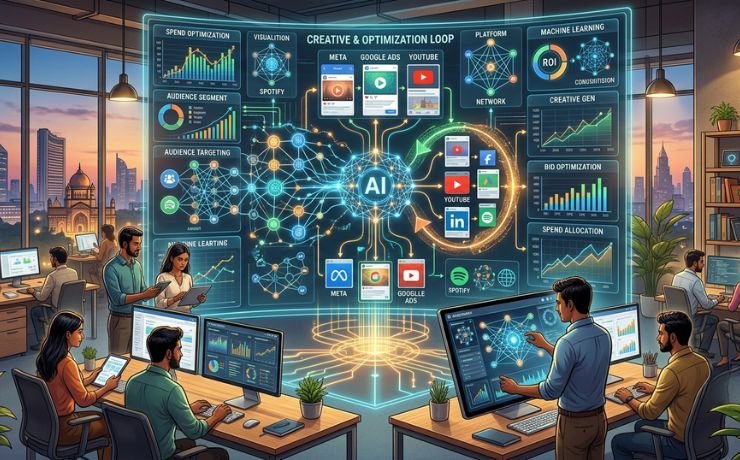
There used to be a person for this. Someone who logged into the dashboard at 9 AM, checked overnight pacing, nudged a bid here, paused an underperforming creative there, and repeated the whole ritual by lunch. In 2026, across a growing number of Indian ad accounts, that person is no longer opening the dashboard at all. Something else is. And it isn’t waiting for instructions.
Agentic media buying — software that doesn’t just suggest what to do with a campaign but actually does it, unsupervised, inside guardrails a human set once and mostly forgets about — has stopped being a conference buzzword and started showing up in actual Indian ad accounts. The shift arrived globally in a single, unusually concentrated burst: in the nine days before Cannes Lions 2026, at least eight major global platforms — DoubleVerify, LiveRamp, Pixalate, Mediaocean, Magnite, Yahoo, Stagwell and Fox — each shipped some version of autonomous buying, coordination or verification infrastructure. India’s own AdTech scene, smaller and scrappier, is racing to build its own version of the same idea.
Assisted Is So 2024
To understand what’s genuinely new here, it helps to be precise about what agentic actually means, because the word has been stretched to cover almost anything with a chatbot bolted on. An AI agent, properly defined, is software that pursues a goal on its own: it reads context, plans a sequence of steps, uses tools and data to act, checks whether the action worked, and decides what to do next — without a human approving each move along the way. That is a meaningfully different animal from a recommendation engine that flags “consider raising this bid” and waits for someone to click yes.
India’s fragmented, high-volume, multi-platform ad ecosystem — where a single mid-sized brand might be running search, social, display, CTV and retail media simultaneously, each with its own dashboard and login — is precisely the kind of complexity agentic systems are built to absorb. Manually reconciling pacing across five platforms before lunch was always a losing game for a human trader. It is exactly the kind of losing game software is good at winning.
Who’s Actually Building This in India
Behind the buzzword, a real cluster of Indian startups is building toward genuinely autonomous execution, each attacking a different layer of the stack.
Adsnex, based out of Navi Mumbai, is perhaps the clearest domestic example of the shift — an advertising operating system built specifically around agentic AI and workflow automation, designed to unify ad creation, campaign management and optimisation across multiple networks rather than leaving a marketer to stitch those pieces together by hand. Marx AI Technology, out of Gurugram, is working the performance-marketing layer specifically, using workflow-based AI to handle competitor analysis and creative ideation while still leaving strategic oversight with the human team — a more cautious, assistive flavour of the same underlying shift. Established players are moving too: DeltaX, one of India’s more established AdTech names, already leans on machine learning and behavioural modelling to optimise media buying and ROI across search, social, display and video. HockeyCurve, out of Mumbai, applies predictive analytics and dynamic personalisation to automate both media buying and creative delivery.
And India’s fingerprints show up on the global stage too — InMobi, through its Glance commerce platform, recently partnered with measurement firm Scope3 to build a sell-side AI agent that acts as an autonomous sales representative for its premium ad inventory, giving international buyers machine-to-machine access to hundreds of millions of devices without a human sales call in the loop.
“The job will be less about building campaigns by hand and more about deciding what the system should optimise toward, which signals it should trust, and when human oversight needs to override the model.”
That’s the shape of the trade every agentic platform, Indian or global, is quietly asking marketers to accept: give up the daily mechanics, keep the judgment calls.
The No-Human-in-the-Loop Extreme — and Why Most Aren’t There Yet
Globally, a handful of platforms have gone further than “agent-assisted” into something closer to “agent-run.” US-based Viant, for instance, has publicly staked its position on a fully autonomous product built around what it calls its “Lattice Brain,” explicitly designed to make optimisation decisions without a human in the loop — in one test campaign for a craft-goods brand, the company reported achieving a cost per action roughly a third of what its human traders had managed on the same budget.
Most of the industry, including most of India’s emerging agentic players, is deliberately not going that far yet. The more common pattern — visible in how DoubleVerify has sequenced its own rollout, launching an insight-generating agent first and holding back a fully autonomous activation agent for a later stage — is to let the machine watch and recommend before it’s trusted to spend unsupervised. That caution isn’t a failure of ambition; it’s a recognition that consequential decisions — the ones with real budget and brand risk attached — still tend to route back to a person, even inside otherwise agentic systems.
What Changes for the Media Buyer’s Job
The mental model worth holding onto is a conductor, not a musician. Agentic systems increasingly play the individual instruments — reading live auction signals, adjusting bids instantly, reallocating budget mid-flight, catching pacing anomalies before a human would ever notice the graph had bent. The buyer’s job shifts toward setting the score: defining what the system should optimise toward, deciding which signals deserve trust, and building the guardrails that decide when the machine should stop and ask.
For India specifically, that shift lands at an interesting moment. The market is simultaneously price-sensitive, chronically understaffed at the trading-desk level, and running some of the most fragmented, multi-platform campaigns in the world thanks to how splintered Indian digital consumption is across language, region and platform. That combination — thin teams, heavy complexity — is exactly the condition agentic systems are pitched to solve. It is also exactly the condition under which handing real budget to an unsupervised system feels riskiest, which is why most Indian agentic platforms today are positioning themselves as co-pilots with strategic oversight retained, rather than pilots flying solo.
The Guardrail Is the Product
The single most important design decision any agentic platform makes isn’t how smart its optimisation is — it’s where it draws the line between “the system decides” and “the system asks.” Get that line wrong in either direction and the product fails: draw it too conservatively and you’ve built an expensive dashboard with extra steps; draw it too loosely and one bad autonomous decision, made at 2 AM with no one watching, can burn through a week’s budget or land a brand’s ad next to content it should never have appeared beside.
That is the real competitive battleground for India’s emerging agentic AdTech players — not who has the flashiest optimisation algorithm, but who has earned enough trust from marketers to be handed the keys a little further each quarter. The brief may increasingly write itself, and now, so might the media plan. Whether an Indian brand is comfortable letting it run unsupervised overnight is still, for most, a question with a very human answer.
