














After First-Price: Whatever happened to bid shading, and who actually benefits

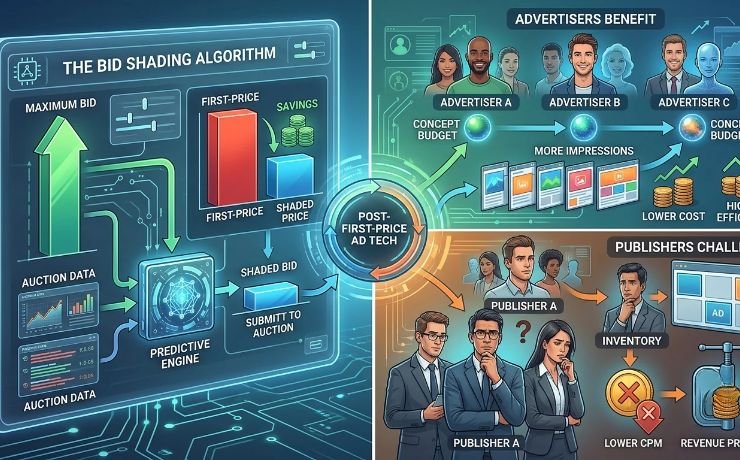
Few changes in the history of programmatic advertising were as consequential, or as quietly absorbed, as the move from second-price to first-price auctions. When Google Ad Manager completed its switch in September 2019, the industry braced for a pricing shock. Publishers hoped for a windfall. Buyers feared a bloodbath. Seven years on, neither prediction played out quite as expected, and the reason has a name that rarely appears on a client presentation: bid shading.
Shading has since become so deeply embedded in buying platforms that most marketers no longer think of it as a decision at all. It is a default setting, a clause in a platform agreement, and occasionally a line on an invoice. That makes it worth asking a question the industry has been oddly slow to answer in public. Now that the dust has settled, who actually benefits?
The rule change that rewired the market
To understand shading, start with what it replaced. In a second-price auction, the highest bidder wins but pays only a cent more than the runner-up, so bidding your true valuation carries no penalty. Buyers could set a number reflecting what an impression was worth to them and let the auction do the rest. In a first-price auction, the winner pays exactly what it bid. A buyer who values an impression at $10 and bids $10, when the next-best offer was $3, hands over the entire difference.
The shift was driven less by ideology than by plumbing. Header bidding, which allowed publishers to solicit bids from several exchanges before calling the ad server, made second-price mechanics unworkable, because a second-price winner entered the downstream comparison at an artificially deflated number. AppNexus, Index Exchange and OpenX led the move through 2017 and 2018. Google announced its transition in March 2019 and began the full rollout on 10 September that year, ending the last-look advantage it had long held. By December 2019, first-price auctions were approaching total share of display, up from around 40 per cent at the start of the year.
The price effects were immediate and hotly disputed. Surveys cited by Yahoo researchers put the rise in average traffic prices anywhere between 5 and 50 per cent, and one report found that 10 per cent of advertisers stopped bidding altogether after their exchange switched. The same researchers estimated that, without some form of shading, costs on their own platform would have roughly doubled.
What shading actually does
Bid shading is the deliberate submission of a bid below the maximum an advertiser would pay. The idea is old. Economists have documented the behaviour in spectrum sales, oil leases and Treasury bill tenders, and its theoretical foundation goes back to William Vickrey’s 1961 work showing that bidders in sealed first-price formats rationally bid below what an item is worth to them. What the advertising industry added was speed and scale.
Inside a demand-side platform, a model predicts the lowest price likely to win a given impression, drawing on historical clearing prices for that publisher, slot, geography, device and time of day. It then bids marginally above that prediction. Take an impression a campaign values at $8, offered with a $2 floor. If the model expects the minimum winning price to land near $3.20, the platform might bid $3.45. The advertiser pays $3.45, and the remaining $4.55 of surplus stays with the buyer instead of going to the publisher.
The models learn from the auctions themselves. The 2016 update to the OpenRTB specification added loss notices, which tell a bidder that it lost and, in many implementations, what it would have needed to bid to win. Google committed to a similar disclosure for Ad Manager in 2019. Each loss became a labelled data point and each win a clearing price. Across billions of auctions, this builds a picture of the competition that no human trader could assemble. Shading, in other words, is not a trick. It is the rational response to a rule change, executed by machines in a few tens of milliseconds.
“Shading is not a trick. It is the rational response to a rule change.”
Real savings, with an asterisk
The headline claims for shading are striking. At launch, AppNexus reported prices 25 per cent lower over 100 days, while Rubicon Project cited a 5 per cent reduction over four months. The Trade Desk said its Koa tool cut publisher rates by around 20 per cent. For a budget of $500,000 clearing at an average of $4 per thousand impressions, the arithmetic is compelling: that buys 125 million impressions, whereas a clearing price of $3.20 buys roughly 156 million.
The asterisk is that almost every one of those figures comes from a vendor selling the tool. There is no widely accepted, independent measure of how much shading has saved the market, nor of how those savings were divided. What the evidence does show is that the technology worked well enough to shift the balance of the auction quite quickly, which is precisely why the other side of the market responded.
“Almost every one of those figures comes from a vendor selling the tool.”
Some of that response came from the exchanges themselves. Google’s AdX operated a Bid Translation Service, Rubicon Project introduced Estimated Market Rate, and AppNexus offered Bid Price Optimization. These sell-side tools lowered buyer prices to keep volume from collapsing during the transition. Yahoo’s researchers made a pointed observation about them: an exchange that shades on behalf of buyers sacrifices its own yield, so its incentives diverge from the advertiser’s, and such services are better understood as keeping impressions sold than as maximising value for the buyer.
A fee surface hiding in plain sight
The more uncomfortable question concerns what happens to the savings on the way to the advertiser. Shading is a fee surface as well as an efficiency tool. Industry reporting has noted that The Trade Desk’s Koa charged a share of the money it saved, and Infillion’s April 2026 buyer guide lists bid shading alongside data onboarding and log-level access among the items a demand-side platform may bill separately, with a warning that not all costs are immediately visible. On the other side, Google’s Display & Video 360 applies a setting called Optimized fixed bidding by default, which the help documentation says is designed to ensure buyers never overpay, and which must be switched off for the stated bid to be submitted in full.
None of this is improper, but the arrangement raises a question every agency should be able to answer: when a platform is compensated from the savings, how closely does the advertiser see the gap between what it was willing to pay and what it actually paid? Typically, the advertiser sees only the final price. The valuation, the predicted landing point and the margin between them sit inside the platform.
That is the core of the criticism. First-price auctions were promoted as the end of the black box between a bid and a clearing price. Shading, critics argue, relocated the opacity rather than removing it, rebuilding on the buy side what the sell side had been asked to give up. The standards bodies have noticed. The Media Rating Council issued draft auction transparency standards in September 2025, and the watchdog Check My Ads Institute objected that the framework risked legitimising opacity. When the IAB Tech Lab published the final version of its Programmatic Auction Definitions on 26 June 2026, it defined 15 terms, including loss notices and bid price. Bid shading was not among them.
“Shading relocated the opacity rather than removing it.”
Publishers answer with floors
Publishers, meanwhile, have not been passive. Their main weapon is the price floor, the minimum a seller will accept, which constrains shading from below. The result is an arms race in which each side’s algorithm trains against the other’s. Yahoo has published results from a floor-setting model built explicitly to change how bidders behave, reporting annualised incremental revenue of 1.3 per cent on display and 2.5 per cent on video inventory. These gains are respectable but modest, and they demand data science that smaller publishers rarely have.
This is where the story acquires a structural edge. Shading and floor-setting are both prediction problems, and prediction rewards scale. Whoever sees the most auctions, and the most loss data, forecasts clearing prices best. That tends to favour the largest platforms on both sides, while mid-sized publishers and independent buyers operate with a narrower view of the market.
“Prediction rewards scale.”
The plumbing is on the move again
The mechanics are now shifting once more. In April 2026, Bedrock Platform became the first demand-side platform to run its bidder inside an exchange, in cryptographically signed containers within Index Exchange infrastructure. The aim is to remove the queries-per-second ceiling that forced buyers to evaluate only a sampled slice of the bid stream. OpenX’s OpenXBuild suite rests on a similar premise, applying partner algorithms inside the exchange itself. Shading logic, in short, is migrating towards the inventory.
Agentic buying adds another variable. A DataBeat report from June 2026, drawing on May data from a network tracking more than 200 bidders, found conventional buyers clearing at an average of $6.95 CPM against $6.13 for agentic buyers, a 13.4 per cent premium, with agentic systems participating in 86 per cent fewer auctions. One report is not a trend, but it hints at something worth watching: buyers who bid more selectively may pay less.
Regulation is also reshaping the field. On 2 September, Judge Leonie Brinkema declined to order Google to sell AdX, choosing behavioural remedies instead. Among them is a requirement that rival publisher ad servers be able to access real-time AdX bids, backed by a six-year oversight regime, and Google has said it will appeal the underlying liability finding. A separate complaint filed by Teads in August alleges that Google ran a programme called Project Poirot that deflated bids into rival exchanges. Those are allegations, not findings, but the distinction they draw is useful. Shading reduces a bid in the advertiser’s interest. Selective bid reduction by a party with a stake in where the impression clears is something else entirely.
So who actually benefits?
The honest answer is that it depends on who can see the data. Advertisers benefit in gross terms: shading demonstrably lowers what is paid per impression compared with naive first-price bidding. Whether the net saving survives platform fees is a question most advertisers cannot currently answer from their own reporting. Platforms and exchanges benefit through fees, volume and the data advantage that comes with sitting in the middle of billions of auctions. Publishers gained transparency about what they are paid, but lost yield to shading and now spend effort on floors to claw some of it back.
If there is a pattern, it is that the parties holding both the bid landscape and the loss data tend to be the most reliable winners. The party furthest from that data, often the brand paying the bills, has the greatest need for visibility and the least of it. That is an argument, not an audit, and the lack of independent measurement is itself part of the story.
“The party furthest from the data, often the brand paying the bills, has the greatest need for visibility and the least of it.”
For marketers and publishers in India, whether buying through global platforms or local ones, the plumbing is the same, and so are the questions. Is shading on by default, and can it be switched off? How is it charged: as a flat platform fee, as a share of savings, or not at all? What is the average gap between my bid and the price I actually paid? Can I see that in log-level data, rather than in a summary slide? And for publishers: which of my buyers are shading hardest, and are my floors responding to it?
First-price auctions were supposed to make programmatic simpler and fairer. In some ways they did. But the industry’s most useful lesson from the last seven years may be that a rule change does not remove complexity so much as relocate it. Bid shading is where much of that complexity now lives, and those who bring it into the open will be better placed than those who leave it as a default.
