














From $15 Billion to $36.7 Billion — What PwC’s Creator Economy Forecast Actually Means for Brand Budgets

There is a number doing the rounds in marketing conversations that deserves more than a headline treatment: $15 billion.
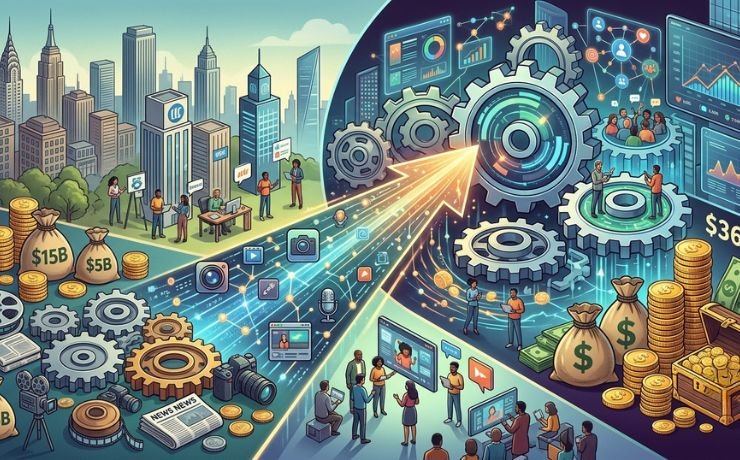
That is roughly the size attributed to India’s creator economy by some recent market estimates. Put that next to PwC’s latest projection that India’s broader entertainment and media market could grow from $25.7 billion in 2025 to $36.7 billion by 2030, and the direction of travel becomes difficult for brands to ignore. PwC’s forecast covers the wider media and entertainment ecosystem rather than the creator economy alone, so the two figures should not be treated as directly comparable. But together, they point to a larger shift: creator-led media is moving from a marketing experiment into a meaningful part of the commercial media landscape.
That distinction matters because the creator economy is often discussed as though it were simply another line item under influencer marketing. It is becoming much more than that.
Creators now sit across discovery, entertainment, community, commerce and brand building. Their content can generate awareness, influence consideration, drive product discovery and, increasingly, become an asset that brands distribute through paid media.
For marketers, therefore, the question is no longer whether creator marketing deserves a budget.
The more important question is what kind of budget it deserves, where that money should come from, and what brands should expect it to deliver.
The $15 billion number is not just about influencers
Market-size numbers can be seductive because they make a fragmented industry look neatly measurable. Creator economies are anything but neat.
The ecosystem includes individual creators, talent managers, influencer agencies, production companies, creator-tech platforms, affiliate businesses, social commerce, subscriptions and platform monetisation. Not every dollar generated around that ecosystem is advertising spend.
That is why marketers should be careful about treating a creator economy valuation as a direct indication of how much brands should spend on influencers.
But the number still tells us something important: the creator ecosystem has developed enough economic infrastructure to be considered a market in its own right.
At the same time, PwC’s latest India outlook puts the country’s overall entertainment and media market at $25.7 billion in 2025 and projects it to reach $36.7 billion by 2030. The forecast reflects growth across a much wider set of categories, including internet advertising, OTT, gaming, traditional media and other entertainment segments.
For brands, the significance lies in the overlap.
Creators are not growing in isolation from the rest of the media economy. They are benefiting from the same forces reshaping it: rising digital consumption, algorithmic discovery, short-form video, streaming, mobile-first behaviour and the migration of advertising towards platforms where audiences increasingly spend their time.
Creator budgets are becoming media budgets
For a long time, influencer marketing lived in a relatively small corner of the marketing plan.
There was the television budget, the digital media budget, the social media budget and, somewhere alongside them, an influencer allocation.
That structure is becoming outdated.
Once a creator’s content is amplified through paid social, used in performance campaigns, adapted for connected TV, distributed through commerce platforms or repurposed into multiple pieces of branded content, it starts behaving less like a sponsorship and more like a media asset.
This changes how the investment should be evaluated.
A creator fee is only one part of the equation. Brands increasingly need to think about production, usage rights, paid amplification, content licensing, whitelisting, platform distribution, measurement and the potential to reuse an asset across campaigns.
The creator is no longer simply buying access to an audience.
The brand is building an asset that can travel through the media ecosystem.
That is a fundamentally different proposition.
The shift from reach to influence
The creator economy has also exposed one of advertising’s oldest measurement problems: reach is easy to count, influence is not.
A creator with five million followers may not necessarily be more useful to a brand than one with 200,000 followers. Audience relevance, trust, category authority, content quality and the relationship between creator and community can matter more than follower count alone.
This is especially important as creator marketing matures.
Early campaigns were often built around visibility. The brief was straightforward: reach as many people as possible and generate engagement.
The next phase is more demanding.
Brands increasingly want creators to perform specific jobs within the consumer journey.
One creator might introduce a category. Another might demonstrate a product. A third might provide social proof. A fourth might drive a purchase through affiliate links or commerce integrations.
That means creator selection is becoming closer to media planning.
The question is not simply, “Who has the biggest audience?”
It is, “Who can influence this particular audience at this particular point in the journey?”
Why the budget conversation is changing now
There is a broader media shift happening underneath the creator boom.
Advertising is becoming an increasingly important part of the global entertainment and media economy, with digital advertising accounting for a growing share of overall media investment. Internet advertising, streaming and other digital formats continue to reshape how audiences discover and consume content.
The implication for marketers is straightforward: more of the media economy is being built around digital environments, and creators are deeply embedded in those environments.
Consumers increasingly discover content through feeds and recommendation systems rather than fixed schedules. Creators, influencers and streamers are becoming increasingly important participants in this decentralised media environment.
That makes creator content part of a larger change in how attention is distributed.
The old media model was built around buying access to audiences.
The creator model is increasingly built around earning attention from communities.
That difference has budget implications.
Creators are becoming distribution partners
One of the biggest mistakes brands can make is to think of creators purely as production partners.
Creators do produce content. But their more valuable asset can be distribution.
A creator already has an audience that understands their tone, habits and point of view. When a product enters that environment naturally, the brand is not starting the communication process from zero.
This is why the strongest creator partnerships increasingly look less like one-off sponsored posts and more like ongoing media relationships.
A creator may work with a brand across a product launch, seasonal campaign, product education series, live event and commerce programme. The brand gets continuity, while the creator gets enough familiarity with the product to make the content feel less transactional.
The implication is that brands should start thinking about creator partnerships with the same long-term lens they apply to other media assets.
The regional creator economy changes the equation
India makes the creator opportunity particularly complex because scale does not mean uniformity.
The country’s creator ecosystem is spread across languages, cities, cultural contexts and interest communities. A creator in Mumbai can speak to a very different audience from one in Jaipur, Kochi, Guwahati or Lucknow, even when the platform is the same.
This fragmentation can look like a challenge from a traditional media-planning perspective.
From a creator perspective, it is an advantage.
Creators allow brands to enter smaller and more specific communities without requiring a single mass-market message to do all the work.
Regional-language creators can make brands feel locally relevant. Niche creators can build authority within categories. Micro-creators can create a sense of familiarity that celebrity-led campaigns may struggle to replicate.
The result is a media market where scale and specificity can coexist.
For brands, that could mean replacing the old question of “How many people can we reach?” with a more useful one: “How many relevant communities can we participate in meaningfully?”
But bigger creator budgets do not mean bigger creator cheques
This is where the $15 billion conversation needs some discipline.
A growing creator economy does not mean brands should simply increase fees across the board.
In fact, greater investment should eventually bring greater scrutiny.
Brands will want better contracts, clearer usage rights, stronger brand-safety processes, more transparent reporting and more sophisticated measurement. Agencies will need better creator databases, audience intelligence and campaign management systems.
Creators, meanwhile, will increasingly need to operate as businesses.
The creator who can offer a loyal audience, consistent production quality, category expertise and measurable commercial outcomes will have a very different negotiating position from someone whose primary asset is a large follower count.
As the market matures, pricing should become less about popularity alone and more about the value of the relationship being created.
Measurement will decide whether budgets scale
The next major phase of creator marketing will be won in measurement rooms, not pitch rooms.
Brands have spent years asking whether influencer campaigns generated engagement. That question is becoming insufficient.
Did the campaign increase brand awareness? Did it influence consideration? Did it generate qualified traffic? Did it contribute to sales? Did the creator audience retain value after the campaign ended?
These questions are harder because creator content does not always behave like conventional performance media.
A creator may influence a consumer today who purchases weeks later. A video may generate no immediate click but significantly improve product familiarity. A creator mention may trigger search behaviour rather than a direct conversion.
This means measurement needs to move beyond last-click attribution.
Brand lift, search lift, assisted conversions, incrementality, engagement quality and customer lifetime value can all become relevant depending on the objective.
The more creator budgets grow, the more pressure there will be to prove that value.
AI will increase the volume, but not necessarily the value
Artificial intelligence is likely to accelerate the creator economy by making content production cheaper and faster.
A single creator can potentially produce more variations, localise content into multiple languages, generate different edits and test more hooks than was possible a few years ago.
But scale creates its own problem.
If every brand can generate hundreds of pieces of content, content itself becomes less scarce. Attention remains scarce.
That makes the creator’s human value more important.
Even as AI transforms advertising and content production, human creativity, judgement, relationships and emotional connection remain important drivers of engagement.
For brands, this means AI should not be treated as a replacement for creator thinking.
It should be used to extend it.
The strongest model may be human creativity supported by machine-enabled production, localisation, optimisation and measurement.
Creators will increasingly sit inside the media mix
The biggest change may be organisational.
Creator marketing can no longer sit entirely with social teams if creators are contributing to awareness, performance, commerce and content production.
Media teams need to understand creator inventory. Creative teams need to understand creator-native storytelling. Procurement teams need to understand usage rights. Legal teams need to understand disclosure and content ownership. Commerce teams need to connect creator activity with conversion.
That is why the creator economy is becoming an operating-model question for brands, not just a campaign question.
The companies that benefit most will likely be those that connect these functions rather than keeping creator activity inside an isolated influencer budget.
The real budget shift is from campaigns to systems
Perhaps the most important lesson from the creator economy’s growth is that brands should stop treating every creator campaign as a standalone event.
The more valuable opportunity is to build a repeatable system.
That system could include a network of creators across different audience tiers, ongoing content partnerships, paid amplification, commerce integrations, measurement frameworks and a clear process for turning high-performing content into broader media assets.
Instead of asking how much to spend on the next influencer campaign, marketers should ask how much infrastructure is required to make creator marketing an always-on capability.
That is a very different budget conversation.
The $36.7 billion question is bigger than creators
PwC’s projection of a $36.7 billion Indian entertainment and media market by 2030 is not a creator-economy forecast. It is a broader industry projection. But its importance to creators lies in what is driving the wider market: digital advertising, streaming, gaming, internet-led consumption and new forms of content distribution.
Creators sit at the intersection of many of those trends.
They create video for digital platforms. They influence product discovery. They participate in commerce. They contribute to streaming and entertainment ecosystems. They provide brands with content that can be distributed across paid and owned media.
That makes them part of the infrastructure of the new media economy, rather than a niche within it.
The next creator budget will look less like an influencer budget
The creator economy’s biggest change is not the size of the market. It is the change in what brands are buying.
They are no longer buying only posts, reels or mentions.
They are buying access to communities, cultural understanding, creative capability, distribution and increasingly measurable commercial influence.
That should change how budgets are constructed.
Creator investment will increasingly need to sit across brand, media, content and commerce rather than being confined to a small social line item.
The $15 billion creator economy figure, therefore, should not be read as a recommendation for brands to simply spend more on influencers. And PwC’s $36.7 billion India media forecast should not be mistaken for a creator-economy valuation.
The more useful takeaway is what happens between the two numbers.
India’s media economy is becoming increasingly digital, fragmented and creator-led. The brands that recognise this early will not necessarily be the ones writing the biggest creator cheques. They will be the ones building the smartest systems around those investments.
Because the creator economy is no longer asking brands for a bigger slice of the marketing budget.
It is asking them to rethink what that budget is supposed to buy.
