














OEM Advertising 101: How Ads Are Reaching Indians Before They Even Open an App

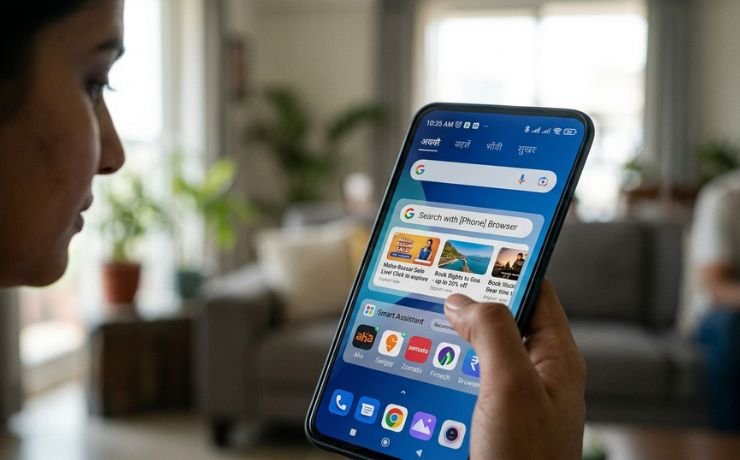
Somewhere between unboxing a new phone and setting up the first fingerprint lock, an Indian consumer has already seen an advertisement. Not on Instagram. Not on YouTube. Not even after connecting to Wi-Fi. It arrives on the lock screen, nestled inside a pre-installed app, or disguised as a “recommended” tile on the home screen — before the SIM tray has been fully closed. This is OEM advertising, and it has quietly become one of the most consequential, least discussed layers of India’s media economy.
For an industry that obsesses over attribution windows, viewability metrics, and the fine print of walled gardens, OEM advertising has managed to stay curiously under the radar. Yet it sits at a vantage point that platforms like Meta and Google can only dream of — the operating system itself. When Xiaomi, Vivo, Samsung, Realme, or Transsion-owned brands like Itel and Infinix ship a phone, they are not just selling hardware. They are handing over a media property with guaranteed daily impressions, zero ad-blocker interference, and access to a user before any app-level privacy consent screen has even loaded.
What exactly is OEM advertising?
OEM, short for Original Equipment Manufacturer, refers in this context to smartphone makers who monetise the device itself as an advertising surface. This isn’t the familiar territory of in-app ads served once a user opens Facebook or a news app. It is advertising embedded at the firmware and system-UI level — lock screens, notification shades, app drawers, browser homepages, and bundled utility apps like file managers, weather widgets, and security scanners that most users never consciously chose to install.
Chinese OEMs, who collectively command a majority share of India’s smartphone shipments, pioneered this model out of necessity. Hardware margins on budget and mid-range devices are razor thin, sometimes in the low single digits. Advertising, alongside data monetisation and bundled app placements, became the way to keep the lights on. A Counterpoint Research breakdown of India’s smartphone market has repeatedly shown budget and mid-range segments — the ₹8,000 to ₹20,000 bracket — dominating volumes, and it is precisely this segment where OEM ad monetisation is most aggressive, because that is where hardware margins are thinnest and the incentive to extract revenue elsewhere is highest.
The result is a new inventory category that media planners are only beginning to formally categorise: pre-app advertising. It exists before the user’s intent is even formed. Someone hasn’t opened Swiggy to order food or Zomato to browse a menu — they’ve simply unlocked their phone to check the time, and an ad for a food delivery app is already sitting on the screen.
The lock screen as prime real estate
Nowhere is this more visible than the lock screen itself. Xiaomi’s MIUI, for instance, has for years run a “Glance” or lock-screen ad unit — full-bleed images and short video creatives that rotate every time the phone is woken up. Similar systems exist across Vivo’s Funtouch OS, Realme UI, and even budget devices running lightly customised Android skins from smaller Transsion brands. These units are typically sold on a CPM basis, but what makes them structurally different from a Instagram Story ad is frequency: a phone might be unlocked 80 to 150 times a day by an average Indian user, according to various device-usage studies cited across the mobile analytics ecosystem. Each unlock is a fresh impression, often before any app has been opened at all.
Then there is the app drawer and the “hot apps” or “recommended” folder — pre-loaded suggestions that sit alongside genuine system utilities, nudging users toward specific apps the OEM has struck a distribution deal with. This is performance marketing dressed as system design. A gaming app or a lending platform doesn’t need the user to search the Play Store; it simply needs to occupy a folder the user opens out of habit, indistinguishable at a glance from a stock Android tool.
Browser homepages complete the loop. OEM-bundled browsers — often the default and, for a large share of first-time smartphone users, the only browser they know — carry curated news feeds, shopping widgets, and sponsored tiles that function like a private ad exchange, invisible to anyone outside the OEM’s own sales team and its handful of programmatic partners.
Why this matters more in India than almost anywhere else
India’s smartphone story has an unusual texture. A significant share of first-time internet users in the country are also first-time smartphone users, arriving directly into a mobile-first, often single-device household where the phone is shared, the data plan is prepaid and metered, and app downloads carry a real cost in both storage and data. In that context, whatever is pre-installed becomes disproportionately influential. A user who has never consciously downloaded a food delivery app might still order through one — because an OEM-bundled shortcut put it in front of them at the exact moment of idle scrolling.
This is fundamentally different from how OEM advertising plays out in markets like the US or Western Europe, where Apple’s dominant share and Google’s tighter Play Store governance leave far less room for manufacturer-level ad insertion. India’s fragmented Android ecosystem, combined with price-sensitive hardware strategies, has created fertile ground for a monetisation layer that simply doesn’t exist at scale elsewhere in the world.
For brands, particularly those in fintech, gaming, quick commerce, and D2C categories chasing Bharat’s next hundred million internet users, this is not a nice-to-have distribution channel. It is often the only channel capable of reaching a genuinely new-to-internet audience before that audience has formed any app habits or brand loyalties at all. Getting a lending app’s icon into a phone’s default folder structure can be worth more than months of performance marketing spend aimed at users who already have twelve competing apps installed.
The murky economics behind the curtain
Where OEM advertising gets genuinely uncomfortable — for regulators, for privacy advocates, and increasingly for the OEMs themselves — is in how little transparency surrounds it. Unlike Google’s or Meta’s ad platforms, which publish policies, offer self-serve dashboards, and are subject to periodic scrutiny over data practices, OEM ad stacks are largely opaque. Deals are struck bilaterally between manufacturers and advertisers or their agencies, inventory is rarely benchmarked against industry-standard viewability or fraud metrics, and there is no equivalent of an IAB standard governing what a “lock screen impression” should even mean.
Several Chinese OEMs have faced scrutiny from Indian regulators and lawmakers over data collection practices tied to these pre-installed systems, with concerns spanning device telemetry, app usage tracking, and the bundling of third-party apps without clear user consent. The Ministry of Electronics and Information Technology has, at various points, pushed for stricter guidelines on pre-installed bloatware and the ability for users to uninstall such apps — a tacit acknowledgment that the current arrangement leaves the user with very little agency over what gets pushed to their screen.
For media agencies trying to plan campaigns responsibly, this opacity is a genuine operational headache. There is no unified measurement currency across OEM inventory the way GRPs standardise television or the way Meta’s Ads Manager standardises social. Every OEM negotiation starts close to scratch, often mediated by a small set of specialised ad-tech intermediaries who have built direct relationships with device manufacturers — companies that, until recently, most planners had never heard of.
Where the category is headed
Two forces are likely to reshape OEM advertising over the next few years. The first is consolidation. As device manufacturers face growing pressure — both regulatory and reputational — to be more transparent about pre-installed monetisation, expect the more organised OEMs to formalise their ad businesses into proper platforms, complete with self-serve buying interfaces, published rate cards, and third-party measurement partnerships. Samsung’s own advertising arm has already moved in this direction globally, and it would be reasonable to expect Indian-focused OEMs to follow, if only to command better CPMs from brands that currently treat this inventory with justified suspicion.
The second is integration with connected TV and smart-device ecosystems more broadly. As the same OEMs — Xiaomi, Samsung, TCL — expand into smart TVs, wearables, and IoT devices sold in India, the lock-screen logic is already extending to TV home screens and smartwatch faces. The same principle that made the smartphone lock screen valuable — capturing attention before intent is formed — applies just as well to a smart TV’s boot-up screen or a fitness band’s notification panel. What began as a smartphone monetisation hack is quietly becoming a cross-device advertising layer.
For India’s advertising industry, the lesson is less about any single OEM’s ad unit and more about a structural shift in where attention actually begins. The funnel used to start with an app open, a search query typed, or a video watched. Increasingly, for a meaningful share of the country’s internet users, it starts earlier than that — at the exact moment a screen lights up. Agencies and brands that continue to plan media purely around app-based platforms are, in effect, arriving at the party after the first ad has already been served. Understanding OEM advertising is no longer an edge case for niche performance marketers chasing Tier 3 growth. It is fast becoming a fundamental literacy requirement for anyone planning to reach India’s next wave of digital consumers.
