














How AI Is Being Used for Real-Time Campaign Optimisation in India

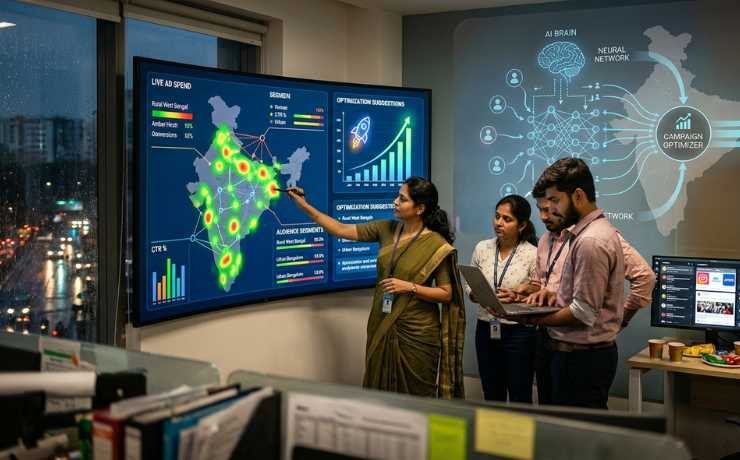
It is 11:47 on a Friday night, and somewhere in a media trading desk in Gurugram, nobody is awake to notice that a fintech client’s app-install campaign has just started underperforming in Pune. Nobody needs to be. By 11:52, the bid has been trimmed, spend has shifted toward Bengaluru and Hyderabad where the same creative is converting twice as well, and a slightly different headline variant has been promoted into rotation. The campaign manager will see the change as a line in a dashboard report the next morning. The algorithm has already moved on.
This is what real-time optimisation looks like in Indian advertising today, and it has quietly become the operating default rather than the exception. For an industry that, not very long ago, treated the weekly campaign review as the unit of decision-making, the shift to systems that reallocate budget, swap creative and adjust bids in minutes rather than days represents one of the more consequential changes in how media actually gets bought and managed in the country.
What makes the Indian context particularly interesting is not that the technology is unique — programmatic optimisation engines, dynamic creative tools and AI-driven bidding systems are global infrastructure built by the same handful of platforms everyone else uses. What is distinct is the scale of fragmentation these systems are being asked to optimise across: twenty-two official languages, a mobile-first audience spread across radically different network conditions, a festive calendar that creates demand spikes measured in hours rather than weeks, and a price-sensitive market where the difference between a profitable campaign and a wasted one often comes down to single-digit percentage shifts in targeting efficiency.
From dashboards to decisions
The starting point for understanding real-time optimisation is recognising what it has replaced. The traditional campaign management cycle in Indian advertising ran on a rhythm of weekly or, at best, daily reporting — a media planner would pull performance numbers, identify underperforming segments, and manually adjust budgets or creative the following day. That cycle made sense when data took time to aggregate and decisions required human sign-off at every stage. It makes considerably less sense when a creative can fatigue within six hours on Instagram Reels, or when a competitor’s flash sale can erode a campaign’s cost-per-acquisition mid-afternoon.
AI-driven optimisation collapses that cycle into something closer to continuous adjustment. Platforms such as Google’s Performance Max, Meta’s Advantage+ suite, and a growing set of India-specific demand-side platforms now run constant micro-experiments across audience segments, placements, bid levels and creative variants, shifting spend toward whatever is working at that moment without waiting for a human to notice the pattern first. For performance marketing categories — quick commerce, fintech, ed-tech, D2C — this has moved from being a competitive advantage to being table stakes; agencies that still rely on manual daily optimisation are, in practice, competing with one hand tied behind their back against rivals whose systems are adjusting every few minutes.
Where this is most visible in India
Three categories illustrate how real-time optimisation is actually being used on the ground, and each reveals something different about why the Indian market rewards this approach particularly well.
Quick commerce has become perhaps the clearest showcase. Platforms in this category run promotional windows that can last a single day or even a few hours, and the cost of a delayed optimisation decision is measured directly in wasted ad spend on a promotion that has already ended by the time a human catches the underperformance. Real-time bidding systems here are tuned to react to inventory and demand signals almost instantly, shifting budget toward dark stores or pin codes with stronger conversion in something close to real time rather than overnight.
Festive and event-driven campaigns are the second clear use case, and arguably the one most specific to the Indian calendar. A campaign built around a cricket match, a festival sale window, or a single-day flash promotion lives and dies within hours. AI systems built to detect spikes in engagement or conversion rate during these windows can reallocate budget toward the platforms and formats driving results while the moment is still happening, rather than producing a post-event report that arrives after the opportunity has closed. Agencies running IPL-adjacent campaigns, for instance, have increasingly leaned on automated bid adjustment to capture attention spikes around key match moments without needing a trading desk staffed around the clock.
The third, less glamorous but arguably more consequential use case is regional and language-level optimisation. A national campaign running creative in Hindi, Tamil, Telugu, Bengali and Marathi simultaneously generates wildly different performance signals across those language cohorts, often for reasons that have nothing to do with the creative quality itself and everything to do with local context, network speed or competing local promotions. AI optimisation engines that can detect a Tamil-language variant underperforming in Chennai while the same campaign’s Telugu variant is overperforming in Hyderabad allow budget to be redistributed at a granularity that would be operationally exhausting for a human team to replicate manually across every market, every day.
The creative layer is catching up
Budget and bid optimisation were the first frontier, but the more recent shift has been the extension of real-time logic into creative itself. Dynamic creative optimisation tools now generate and test multiple versions of an ad — different headlines, different product images, different calls to action — and let the system identify which combination is converting best for which audience segment, swapping underperforming variants out within the campaign’s first few hours rather than waiting for a scheduled creative refresh.
This matters enormously in a market where creative fatigue sets in fast. Indian mobile users, particularly on platforms like Instagram and YouTube Shorts, scroll through enough content daily that a single ad creative can lose effectiveness within days. Brands running always-on performance campaigns have started treating creative not as a fixed asset approved once at the start of a campaign, but as a living set of variables the AI system is continuously testing and recombining — closer to how a website’s landing page might be A/B tested than how a traditional television commercial was ever managed.
For agencies, this has changed what creative production actually needs to deliver. Instead of producing one polished hero asset, teams are increasingly asked to produce modular creative components — multiple headline options, multiple visual treatments, multiple CTAs — specifically so the optimisation engine has enough raw material to test against. The skill set this demands looks less like traditional campaign craftsmanship and more like building a library of interchangeable parts for a machine to assemble on the fly.
What this means for the people in the loop
None of this has eliminated the human role in campaign management, but it has changed what that role actually consists of. The campaign manager who once spent the bulk of their week pulling reports and manually shifting budgets is, in well-run setups, now spending that time on strategy that the AI cannot do for itself: deciding what counts as a meaningful success metric, setting the guardrails within which the optimisation engine is allowed to operate, and catching the cases where an algorithm is optimising for the wrong signal entirely.
That last point deserves attention, because it is where some of the more visible failures in real-time optimisation have occurred. Systems tuned purely to maximise short-term conversion signals can, left unchecked, drift toward decisions that look efficient on a dashboard but are quietly damaging to brand equity — overspending on remarketing to the same narrow audience, favouring clickbait-style creative that converts but erodes trust, or chasing vanity engagement metrics that do not translate into actual business outcomes. Agencies that have adopted real-time optimisation most successfully tend to be the ones that have invested as much in defining the guardrails and success metrics upfront as they have in the optimisation technology itself.
There is also a data quality dependency that is easy to underestimate. Real-time optimisation is only as good as the signal it is reacting to, and in a market where attribution across fragmented platforms, app ecosystems and offline conversion points remains genuinely difficult, AI systems can end up optimising confidently against incomplete or misleading data. Brands and agencies investing in real-time bidding without first investing in clean, unified measurement infrastructure are, in effect, handing a fast car to a driver working from an outdated map.
Where this goes next
The trajectory from here looks less like a single dramatic leap and more like a steady widening of what gets automated. Predictive optimisation — systems that anticipate a performance dip before it happens, based on early signals, rather than reacting after the fact — is already moving from research demos into production tools at the larger platforms. Cross-channel optimisation, where a single AI layer manages budget allocation across search, social and programmatic simultaneously rather than within each platform’s own walled garden, is the next significant frontier, and the agencies building proprietary tooling on top of platform APIs to achieve this are positioning themselves for a meaningful competitive edge over those relying solely on each platform’s native optimisation tools.
What seems unlikely to change is the underlying logic that has made real-time optimisation indispensable in the Indian market specifically: a mobile-first, linguistically fragmented, festival-driven audience that rewards speed and granularity in ways slower-moving markets simply do not feel as acutely. The agencies and brands that treat this as infrastructure to be built thoughtfully, with clear guardrails and clean data underneath it, are likely to be the ones who turn real-time optimisation into a durable advantage rather than just a faster way to make the same mistakes.
