













Podcast-First Creators Are Building Media Empires — What Brands Need to Know Before Sponsoring One

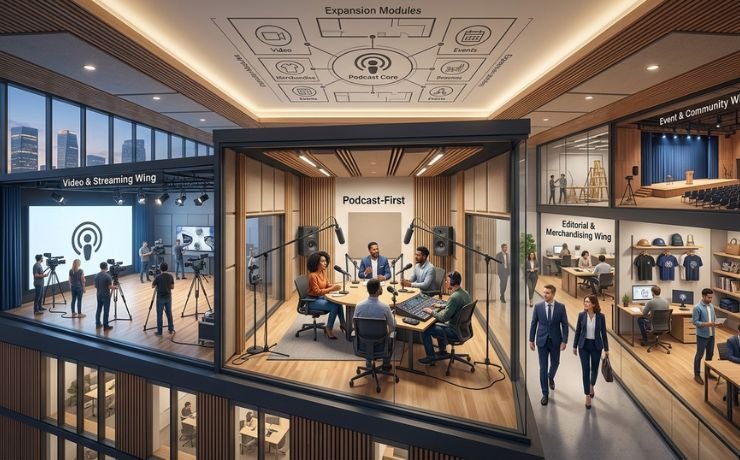
There is a particular kind of media company being built right now that does not look like a media company at all. It has no newsroom, no studio lot, no glass-walled boardroom overlooking a city skyline. It has a microphone, a spare room converted into a recording booth, an editor working freelance from another city, and a founder who is also, inconveniently for the org chart, the talent. And yet these operations are pulling in sponsorship revenue that would make a mid-sized digital publisher blush, commanding CPMs that outperform most display inventory, and building audience relationships so durable that brands are now queuing up to be associated with them. The podcast-first creator has quietly become one of the most consequential media entities in the modern marketing stack, and a surprising number of brand teams still don’t have a coherent framework for dealing with them.
This isn’t a story about podcasting as a format anymore. It’s a story about vertical integration — creators who started with a single show and have since built out YouTube channels, newsletters, live events, merchandise lines and, in some cases, their own production companies that now produce shows for other hosts. The individual is functioning as a full-stack media brand, and the sponsorship deal that used to be a simple pre-roll read has become something closer to a strategic partnership negotiation, with all the complexity that phrase implies.
The economics that changed the conversation
To understand why brands are suddenly paying close attention, it helps to look at what podcast advertising actually delivers relative to its cost. Host-read ad reads on established podcasts routinely command CPMs in the range of ₹1,500 to ₹4,000 for premium shows with engaged, niche audiences — figures that look extraordinary next to programmatic display, but make more sense once you account for completion rates. A pre-roll banner ad has to fight for a fraction of a second of attention against forty open browser tabs. A host-read ad in a podcast a listener has actively chosen to download, and is often listening to during a commute, a workout or a chore, gets consumed at completion rates that frequently exceed ninety percent. Attention, in other words, is not being estimated. It is functionally guaranteed by the format itself.
“We stopped thinking of it as media buying and started thinking of it as talent partnership,” said a category lead at a D2C wellness brand that has run sustained sponsorships across three Indian business and lifestyle podcasts over the past eighteen months. “The moment you treat the host like an influencer instead of an ad slot, the whole negotiation changes.”
That reframing — from ad slot to talent partnership — is precisely what separates a sophisticated podcast sponsorship strategy from a lazy one, and it’s where most brand teams still stumble. Buying a podcast ad the way you’d buy a radio spot, with a script handed down from the brand’s ad agency and read verbatim by a host who clearly doesn’t believe a word of it, is the single fastest way to torch the credibility that made the placement valuable in the first place.
Reading the empire, not just the show
The first mistake brands make is evaluating a podcast-first creator purely on the metrics of the flagship show — download numbers, average listenership, episode frequency — without accounting for the full ecosystem the creator has built around it. A creator with a modest but growing podcast audience of forty thousand downloads an episode might also command a YouTube channel with several hundred thousand subscribers where full episodes are repurposed as long-form video, a newsletter with a healthy open rate reaching a separate segment of the audience, and a live-events business that sells out venues twice a year. Sponsoring the podcast alone, in that scenario, is buying one room in a house.
Media and marketing teams that are getting this right have started asking creators for a full cross-platform audience breakdown before committing spend — not just downloads, but watch-time on video repurposes, newsletter subscriber overlap, social follower composition, and increasingly, first-party data the creator has collected through community platforms, Discord servers or paid membership tiers. The creators running the tightest operations can now produce something close to a media kit that would not look out of place from a mid-sized publisher, complete with audience demographics, geographic breakdowns and engagement benchmarks by content type. The ones who can’t — or won’t — produce that data are usually a signal in themselves about how seriously the operation is being run.
The trust economy, and its fragility
What brands are really buying when they sponsor a podcast-first creator is borrowed trust — the accumulated credibility a host has built over months or years of consistent, honest engagement with an audience that has chosen to let that voice into their earbuds on a recurring basis. This is a fundamentally different transaction from buying reach on a billboard or a banner ad, and it carries a different set of risks that most brand safety frameworks, built for programmatic and social media, were never designed to catch.
The trust economy cuts both ways. A well-matched sponsorship, where the host genuinely uses and believes in the product, can generate conversion rates and brand recall that outperform almost any other channel in a marketer’s toolkit — several performance-marketing-led D2C brands in India have reported that podcast sponsorships, tracked through dedicated promo codes and landing pages, deliver customer acquisition costs meaningfully lower than their paid social spend, particularly for considered-purchase categories like financial products, skincare and wellness. But a poorly matched sponsorship, or worse, a host whose off-air conduct or on-air opinions later become controversial, transfers reputational risk to the brand with a speed and intimacy that a traditional celebrity endorsement rarely matches, precisely because the audience feels a parasocial closeness to the host that makes any perceived betrayal feel personal.
This is why the due diligence brands run on creators has had to mature considerably. It is no longer sufficient to check follower counts and engagement rates. Sophisticated brand teams are now reviewing a creator’s back catalogue for tone and consistency, checking how the host has handled past sponsorships and whether audience sentiment in comments and reviews suggests the sponsorships felt authentic or forced, and increasingly building morality and conduct clauses into contracts that would have seemed excessive for a podcast deal even three years ago.
Negotiating like it’s talent management, not media buying
The deal structures themselves have evolved considerably from the simple thirty-second host-read at a flat rate. Brands with longer time horizons are increasingly negotiating multi-episode arcs rather than one-off placements, on the reasonable premise that repeated, consistent exposure across several episodes builds recall in a way a single mention cannot. Equity-for-endorsement arrangements, once rare outside of Silicon Valley creator deals, are beginning to appear in the Indian market too, particularly where an early-stage D2C brand wants a creator’s long-term incentive aligned with the brand’s growth rather than a one-time fee. And affiliate and promo-code structures, layered on top of a base sponsorship fee, are now close to standard practice, giving brands a genuine performance-attribution layer that podcast advertising historically lacked.
Creative control is the other area where negotiations have grown more sophisticated. The best-performing sponsorships tend to give the host meaningful latitude to integrate the product into their own voice and format rather than handing over a rigid script, but brands understandably want guardrails around claims, especially in regulated categories like finance and health where an enthusiastic but imprecise host read can create genuine compliance exposure. The brands doing this well have moved toward a briefing document rather than a script — key messages, mandatory disclosures, claims to avoid — and then trust the host to deliver it in their own idiom, treating the relationship less like a media insertion order and more like a creative collaboration with a co-author who happens to have an audience.
What measurement still can’t quite capture
For all the sophistication that has crept into how brands evaluate and negotiate with podcast-first creators, measurement remains the category’s honest weak point. Podcast listening is inherently harder to track than a webpage view or a video watch-time metric; app-level analytics vary wildly in quality across platforms, and cross-device listening — starting an episode on a phone during a commute, finishing it on a smart speaker at home — makes unified attribution genuinely difficult. Promo codes and dedicated landing pages help, but they undercount the brand-building, top-of-funnel value that a sponsorship delivers simply by association, the kind of effect that shows up in brand lift studies rather than click-through data.
That measurement gap has not slowed the money flowing into the category, and there is a reasonable argument that it shouldn’t — the format’s strength has always been depth of attention rather than precision of tracking, and brands chasing podcast sponsorships purely for last-click attribution numbers are likely optimising for the wrong outcome. What it does mean is that brand teams entering this space need internal alignment, before the deal is signed, on what success actually looks like and how it will be judged, because a channel this qualitatively powerful and quantitatively fuzzy tends to expose the difference between marketing teams that have a real point of view on brand-building and those that have simply been running performance playbooks by default.
The podcast-first creator economy is not a passing trend riding a pandemic-era audio boom. It is the early architecture of a new kind of media company — smaller, more personal, harder to standardise, and considerably more durable in the relationship it builds with an audience than almost anything else in a modern marketer’s toolkit. Brands that treat it with the seriousness of a talent partnership, rather than the convenience of a media buy, are the ones most likely to find that durability working in their favour.
