














Non-Metro CTV: How Broadband Expansion Is Quietly Building a Bharat Streaming Audience

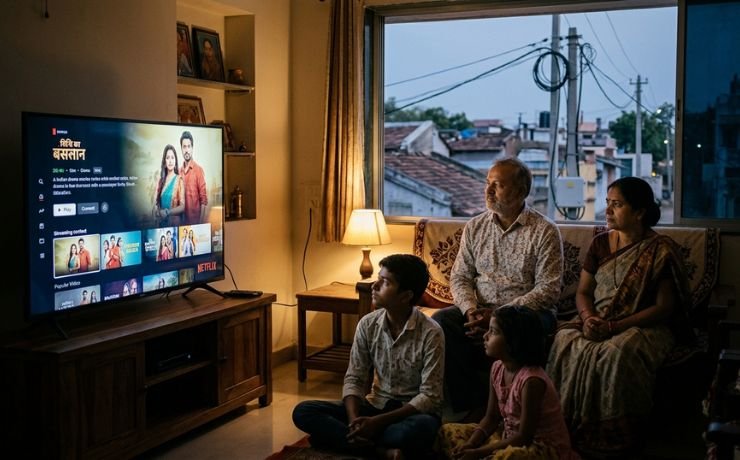
For years, the story of India’s streaming boom was largely told through the lens of metros. Mumbai, Delhi, Bengaluru, Hyderabad and a handful of other large cities became shorthand for India’s digital consumer: young, mobile-first, subscription-ready and increasingly comfortable moving from linear television to streaming.
That picture is becoming incomplete.
The next phase of India’s streaming growth is being shaped less by the expansion of OTT platforms into new cities and more by the infrastructure quietly making those cities, towns and smaller communities viable markets in the first place. Broadband availability, cheaper connected devices, expanding fibre networks, affordable data and the spread of smart TVs are changing what the television screen means outside India’s traditional media centres.
The scale of the shift is already visible. India had an estimated 958 million active internet users in 2025, with rural India accounting for around 548 million of them. More importantly, rural internet users grew at a significantly faster pace than their urban counterparts. The result is not simply a bigger internet population. It is a new audience base increasingly capable of consuming video beyond the smartphone.
That distinction matters for advertisers.
CTV is not merely bringing OTT content to the television screen. It is creating a bridge between the reach of mass television and the addressability of digital media. As connectivity improves beyond the metros, that bridge is beginning to extend into India’s non-metro markets.
Broadband Is Becoming the Infrastructure Behind the Next Streaming Wave
Streaming growth is often attributed to content. A hit series, a major sporting event or a regional-language original can certainly accelerate adoption. But content can only create demand when the infrastructure exists to deliver it consistently.
This is where broadband becomes strategically important.
India’s internet expansion has moved well beyond the first generation of mobile connectivity. Fibre broadband, fixed wireless access, 5G and improvements in last-mile connectivity are creating more reliable conditions for sustained video consumption. For households that once depended almost entirely on linear television, broadband can turn the television set into an internet-connected entertainment hub.
The significance of this change is easy to underestimate because internet penetration is usually discussed in terms of users rather than screens. A person watching short-form video on a smartphone is part of the digital economy, but a household streaming a two-hour film on a connected television represents a different advertising environment.
The screen is larger. Viewing is more likely to be shared. Content sessions can be longer. And the device sits in a domestic environment that resembles traditional television while retaining many of the targeting and measurement possibilities associated with digital media.
That combination is particularly relevant to Bharat, where television has historically been a household medium rather than an individual one.
The CTV Audience Is No Longer a Metro-Only Proposition
The numbers surrounding connected television are changing quickly. Ormax Media estimates that India’s CTV audience reached 206.9 million people in 2026, up 60% from 129.2 million in 2025. Its broader OTT universe also expanded to an estimated 664.9 million users.
Those figures should not be interpreted as evidence that every new CTV viewer is sitting in a smaller town. CTV measurement and definitions vary across reports, and audience growth is not distributed evenly across geographies. But the direction is difficult to ignore: connected television is moving from being a premium urban extension of OTT towards becoming a mainstream part of India’s digital video ecosystem.
That creates an interesting contradiction for marketers. The CTV conversation is often framed around premium audiences, large screens and high-value households. At the same time, the infrastructure supporting those screens is expanding into markets where television has always had enormous cultural importance.
In other words, CTV may be entering Bharat through a very familiar door: the television set.
For Bharat, Streaming Does Not Have to Mean Cord-Cutting
One of the assumptions carried over from mature streaming markets is that OTT adoption necessarily means abandoning traditional television. India’s media behaviour is more complicated.
A household can watch a daily soap on linear television, cricket through a streaming app, YouTube on a smart TV and short-form content on smartphones, sometimes within the same day. The transition is therefore less about replacing one screen with another and more about adding layers to the household’s media consumption.
This is particularly important outside major metros.
For many consumers, the connected television is not necessarily a symbol of cord-cutting. It can be an upgrade to an existing television habit. The household still values familiar television genres, but now has access to a much wider catalogue of films, series, sports, news, music and creator content.
That creates a different opportunity for streaming platforms and advertisers. Instead of asking whether OTT will replace television, the more useful question is how streaming is changing what television can deliver.
Regional Content Could Be the Real Accelerator
Infrastructure may make streaming possible, but content determines whether people keep watching.
India’s non-metro audience is not a single demographic block waiting for metropolitan content to arrive. It is made up of distinct linguistic, cultural and consumption communities. The opportunity therefore lies not simply in distributing Hindi or English content more widely, but in building programming around local viewing habits.
Regional-language entertainment has already demonstrated its ability to expand the digital audience. Streaming platforms have increasingly invested in Tamil, Telugu, Malayalam, Kannada, Marathi, Bengali and other language markets, while dubbed content has made national programming more accessible across regions.
The connected television can amplify that opportunity because it changes the context in which regional content is consumed.
A regional film watched on a phone is a digital viewing event. The same film watched by a family on a 55-inch television becomes a shared entertainment experience. That distinction can influence everything from content discovery to advertising formats.
For brands, it also creates a route into cultural conversations that are often difficult to replicate through nationally standardised media plans.
The Advertiser’s Bharat Problem Is Changing
For decades, media planners have had to make a familiar trade-off. Television offered scale but relatively broad targeting. Digital offered targeting and measurement but was historically associated with smaller screens and fragmented attention.
CTV complicates that trade-off.
It can bring the large-screen environment of television together with digital audience segmentation. A campaign can potentially be planned around geography, content environment, audience characteristics and viewing behaviour while still appearing in a television-like setting.
For a brand entering a Tier 2 or Tier 3 market, this opens up interesting possibilities.
A consumer-goods brand could use connected television to build awareness around a regional-language launch. A financial services company could use contextual content environments to introduce a new product. An automobile brand could combine CTV video with mobile retargeting. An ecommerce player could connect video exposure with subsequent digital journeys.
The value is not simply in reaching a non-metro household. It is in understanding that household as part of a connected media journey.
But Reach Alone Will Not Be Enough
The temptation with every emerging audience is to celebrate the size of the opportunity before addressing the quality of the infrastructure around it.
CTV still has unresolved questions around measurement, frequency management, fragmentation, identity, inventory quality and attribution. Different platforms can define a connected-TV user differently. A household, a television device and an individual viewer are not interchangeable units of measurement.
That becomes more important as CTV expands beyond the most sophisticated media markets.
If an advertiser reaches the same household through multiple OTT services, is that frequency being understood correctly? If several members of a family use the same connected television, how should the audience be defined? If a viewer starts watching on a smartphone and finishes on a television, which device receives the credit?
These are not technical footnotes. They determine how marketers value the medium.
The next stage of CTV growth will therefore depend not only on more screens and more broadband connections, but on stronger measurement standards and clearer definitions of audience, reach and incremental impact.
The Economics of the Non-Metro Screen
There is another reason Bharat matters to the CTV story: economics.
As connected-device adoption expands, advertisers gain access to audiences that were previously difficult to address with precision through television. At the same time, publishers and platforms gain an opportunity to monetise inventory beyond the most competitive metropolitan markets.
This could gradually change how media planners think about geographic segmentation.
Instead of treating non-metro audiences primarily as an extension of national television reach, brands can increasingly build digital video strategies around specific states, languages, cities and consumer cohorts.
The distinction becomes particularly useful for categories whose growth is closely linked to India’s next wave of consumption: fintech, ecommerce, consumer electronics, automobiles, personal care, education, healthcare and new-age financial products.
For these categories, the next customer may not live in a metro. But they may increasingly watch content on a connected screen.
From “Bharat” as a Media Bucket to Bharat as a Media Market
There is a broader lesson here for the advertising industry.
“Bharat” has often been used as a convenient shorthand for everyone outside India’s largest cities. That framing risks flattening enormous differences in language, income, culture, infrastructure and media behaviour.
The rise of connected television makes that simplification harder to sustain.
A household in Jaipur, a family in Coimbatore and a consumer in Lucknow may all be non-metro audiences, but their content preferences and purchase journeys can be very different. Broadband does not erase those differences. It makes them more addressable.
This is where the next generation of media planning will have to become more nuanced.
The question will not simply be, “Can we reach Bharat?” It will be, “Which Bharat are we reaching, through which screen, in which language, in what context and with what measurable outcome?”
The Living Room Is Becoming Part of the Digital Funnel
Perhaps the most significant change is happening at the intersection of television and performance marketing.
For a long time, the living-room screen sat at the top of the funnel. Television created awareness, while digital channels handled consideration, engagement and conversion.
Connected television is gradually blurring those boundaries.
A CTV impression can be targeted more precisely than a conventional broadcast spot. It can be measured alongside digital activity. It can sit within a broader programmatic campaign. And increasingly, it can become part of a journey that moves from video exposure to mobile search, website visits, app activity or purchase.
That does not mean every CTV impression should be judged like a performance ad. The strength of the large screen remains its ability to create attention and brand memory. But the ability to connect that attention with measurable downstream behaviour changes the strategic conversation.
What Comes Next
India’s next streaming audience may not arrive with the same profile as the first one.
It may be more regional, more multilingual and more household-oriented. It may use free and paid services interchangeably. It may discover content through social platforms, watch it on mobile and consume the full programme on television. It may not think of itself as an “OTT audience” at all.
That is precisely why the broadband story matters.
Connectivity is quietly removing one of the biggest barriers between digital video and India’s non-metro households. As the infrastructure matures, the connected television becomes less of a premium technology purchase and more of a natural extension of the digital home.
For advertisers, the opportunity is not simply another channel to buy. It is a shift in where the digital consumer can exist.
The next CTV growth story may therefore be less about convincing metropolitan consumers to watch more streaming content and more about recognising that millions of consumers outside the traditional media centres are already building their own viewing habits.
Broadband is giving them the connection. Smart TVs are giving them the screen. Streaming platforms are giving them the content.
The advertising industry now has to figure out how to make that audience count.
