














Retail Media Hits ₹6,000 Crore: Is Quick Commerce Advertising Already Peaking or Just Getting Started?

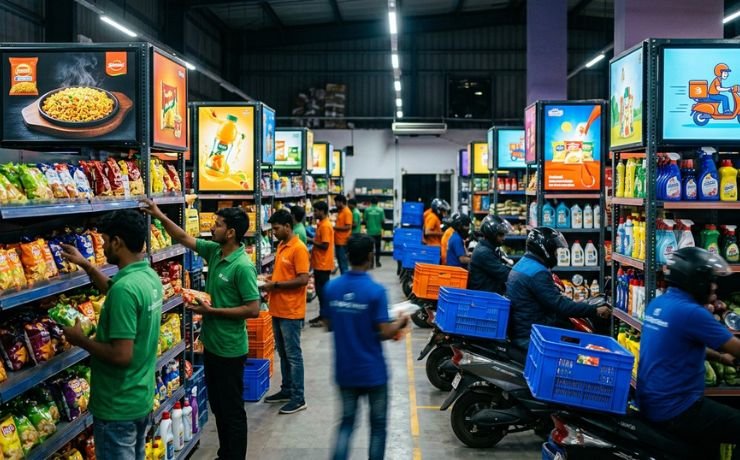
There is a particular kind of number that industry watchers love to argue about, and ₹6,000 crore is fast becoming one of them. That is the figure the Pitch Madison Advertising Report (PMAR) 2026 has attached to quick commerce advertising spend for the calendar year — a projection that, on paper, looks almost unremarkable next to India’s sprawling ₹1.74 lakh crore ad economy. But sit with the trajectory for a moment. Quick commerce ADEX stood at a modest ₹1,325 crore in 2024. It nearly tripled to ₹4,000 crore in 2025, a 202% jump that few categories in Indian media have ever managed in a single year. Now it is expected to climb by another 50% to touch ₹6,000 crore in 2026. That is not a category finding its footing. That is a category in a sprint, and the question everyone in the business is now quietly asking is whether the sprint has a finish line in sight, or whether this is simply what quick commerce advertising looks like when it is just getting started.
To understand why this number matters as much as it does, it helps to place it inside the larger retail media story. Advertising on major e-commerce platforms — Amazon, Flipkart and their peers — reached ₹10,257 crore in 2025, growing 27% year on year, already one of the fastest-growing slices of core digital spend. Add quick commerce to that pile and, depending on whose framework you use, retail media as a whole is being sized anywhere between a five-figure-crore “media-to-money” engine (per PMAR) and a category crossing ₹30,000 crore in 2026, roughly 15% of India’s total ad revenue, according to WPP Media’s This Year, Next Year (TYNY) report. The exact figure shifts depending on definitions and what gets counted as “retail media” versus “e-commerce advertising” versus “quick commerce ADEX.” What does not shift is the direction. Every major measurement body tracking Indian advertising in 2026 is pointing at commerce-adjacent media as the fastest-growing line item on the sheet, and quick commerce is the loudest, most visible piece of that story.
The reason is not difficult to locate. Quick commerce platforms — Blinkit, Zepto, Swiggy Instamart, and more recently Flipkart Minutes and Amazon Now — sit at the exact point where attention becomes a transaction. A consumer opening the app is not idly scrolling; they are, in the language marketers now use with almost religious regularity, “already in commerce mode.” The distance between seeing a sponsored listing and adding it to a cart is measured in seconds, not the days or weeks that separate a television spot or an Instagram reel from an eventual purchase. For a marketing organisation under constant pressure to prove return on ad spend, that proximity to the till is close to irresistible. It converts advertising from a belief system — trust the brand, trust the reach, trust the recall — into something that behaves more like a performance channel, with dashboards, click-through rates and same-day sales lift to show for it.
This is also precisely why the platforms themselves have leaned into advertising with such intensity. Quick commerce as a business model has always carried a structural problem: delivering a low-value basket in ten minutes is expensive, and the unit economics of grocery delivery rarely cover the cost of the last mile on product margin alone. Advertising has emerged as the fix, or at least the most promising patch. It is high-margin revenue that does not require another dark store or another fleet of riders. Sponsored search results, “visibility boosts,” listing fees and premium placement packages have effectively become a second business layered on top of the delivery business, and in some cases a more profitable one. Datum Intelligence estimates combined advertising revenue for Blinkit, Zepto and Instamart could touch roughly ₹4,900 crore by the end of 2026, up from around ₹3,000 crore in 2025. Zepto’s own IPO filing disclosed advertising revenue surging 151% to ₹1,636 crore in FY26, now accounting for more than 7% of its operating revenue — a figure that is being watched closely by public market investors precisely because it offsets thinner commission income and helps the platform hold consumer prices competitive. Blinkit has not broken out its advertising revenue as a standalone line, but Eternal’s management has repeatedly noted that quick commerce already generates more ad income as a share of order value than food delivery does, which says a great deal about where the company’s own priorities are shifting.
None of this has gone unnoticed by the brands writing the cheques. FMCG companies, in particular, have found in quick commerce a channel that behaves unlike almost anything else in their media mix. Unlike Amazon, where a shopper might type a specific brand name into a search bar and scroll through thousands of listings, quick commerce browsing tends to be generic — someone searches “shampoo” or “sunscreen” rather than a brand, and chooses from a comparatively narrow assortment. That difference changes the entire logic of the media buy. Winning the sponsored slot at the top of a category page on Blinkit or Zepto is not a nice-to-have; for many brands it is close to the entire battle, because the alternative is invisibility in a moment when the consumer is actively ready to buy. It is this dynamic that has pushed listing fees, sponsored placements and “Product Booster” style tools from a peripheral spend line into a core part of the annual media plan for consumer goods companies, many of which are now routing a meaningful share of their performance marketing budgets — some industry estimates put quick commerce’s share of FMCG e-commerce sales as high as 70% — directly into these platforms.
The competitive intensity among the platforms themselves has only sharpened this arms race. Blinkit continues to lead on scale, having processed over 916 million orders in FY26 against Zepto’s roughly 640 million and Instamart’s 412 million, and posting revenue of ₹37,779 crore for the year against Zepto’s ₹22,623 crore and Instamart’s ₹3,859 crore. But Zepto has closed the gap on order velocity and has been the most aggressive of the three in monetising through advertising as it heads toward a public listing, while Instamart continues to lean on Swiggy’s broader ecosystem even as it works to narrow its losses. Add Flipkart Minutes, leaning hard into connected TV and OTT to build Tier-1 awareness, and Amazon Now, still playing catch-up on brand-building surfaces, and what emerges is five well-capitalised platforms all racing toward the same conclusion: that advertising revenue, not delivery fees or product margin, is the fastest and cleanest route to something resembling profitability. Combined, the top three quick commerce players are estimated to have spent over ₹2,200 crore on advertising and promotions of their own in FY26, an unusually high figure that underlines just how much is riding on winning consumer mindshare in this category.
So, back to the original question. Is retail media in quick commerce peaking, or is it just getting started? The honest answer is that the two are not mutually exclusive, and the more useful way to think about it is by separating the growth rate from the growth base. A 202% jump, as the category posted in 2025, was always going to be difficult to sustain — and indeed, PMAR’s own projection of 50% growth for 2026 is itself a sign of deceleration, even as the absolute number keeps climbing impressively. That is not peaking; that is maturing, which is a very different thing. A category growing 50% a year on a ₹4,000 crore base is still, by any conventional measure, in its early innings. Quick commerce’s overall market itself is projected by Deloitte India to reach $250 billion by 2030, and Redseer projects the sector growing 40-45% annually with quick commerce accounting for around 10% of branded retail by then. Advertising revenue, tracking closely behind order volume and platform scale, has considerable runway left simply by virtue of riding that underlying commerce growth.
What is more likely to change is the texture of the spend rather than its size. The early phase of quick commerce advertising was defined by relatively blunt instruments — pay-to-be-seen listing fees, basic sponsored search, blanket visibility packages. As the platforms mature and accumulate richer first-party data on browsing behaviour, repeat purchase patterns and basket composition, the next phase is likely to look more like what Amazon built over the past decade: tiered ad formats, better targeting, measurement tools that speak the language of brand marketers as much as performance marketers, and eventually, formats that blend awareness and conversion rather than treating them as separate budgets. Some of that evolution is already visible in the shift toward connected TV and influencer-led campaigns that platforms like Zepto and Flipkart Minutes are running alongside their in-app advertising businesses, effectively building a full-funnel media stack rather than a single conversion-focused tool.
There is also a structural tailwind that should not be underestimated: measurement itself. In a media landscape where marketers are under constant pressure to justify every rupee spent, a channel that can show same-day sales attribution has an inherent advantage over one that can only promise reach and recall. As CFOs across FMCG, personal care and consumer electronics companies tighten scrutiny on marketing ROI, quick commerce’s ability to close that loop — impression to cart to delivery, sometimes within the hour — gives it a structural edge that traditional media simply cannot replicate. That is unlikely to reverse itself, regardless of how the growth percentages moderate over the next few cycles.
The more interesting risk sitting underneath the headline number is less about demand and more about supply-side discipline. As every quick commerce platform leans harder into advertising to plug profitability gaps, there is a genuine question of how much sponsored inventory a category page can absorb before it starts to erode the very immediacy and trust that made these platforms valuable to advertisers in the first place. A shopper who opens Blinkit for a ten-minute grocery run and is met with five sponsored placements before the organic result they were looking for is a shopper whose experience is being quietly taxed for the platform’s benefit. Platforms that manage this balance with restraint are likely to sustain advertiser trust and premium pricing power for longer; those that don’t may find brands recalculating whether the ROI still holds once ad clutter starts denting conversion rates.
For now, though, the numbers tell a fairly unambiguous story. ₹6,000 crore is not a ceiling; it is a waypoint in a category that has gone from a rounding error to a genuine pillar of India’s advertising economy in under three years. The platforms building it are still investing heavily in their own advertising infrastructure, the brands funding it are still finding it more measurable than almost anything else in their kit, and the underlying commerce business it rides on is still expanding at a pace few other retail formats in India can match. Quick commerce advertising may be growing more slowly than it was twelve months ago. But slower growth on a base that keeps compounding is still, by any reasonable definition, an industry that is just getting started.
