












How a Legacy FMCG Brand Rebuilt Its Media Mix Around CTV and Retail Media


For decades, the media playbook for a large FMCG brand was relatively predictable. Television built reach. Print added credibility. Outdoor reinforced presence. Digital filled the gaps, increasingly taking on the job of targeting and performance. The objective was straightforward: reach as many relevant consumers as possible, often through broad demographic proxies, and stay visible across the purchase cycle.
That model is becoming harder to defend.
Consumers now move between streaming platforms, social feeds, search engines, quick-commerce apps, marketplaces and physical stores with little regard for the boundaries that once separated media channels. The same consumer who watches a cooking show on a connected television may search for a product on Google, compare prices on a marketplace and eventually add it to a quick-commerce basket.
For legacy FMCG brands, this shift is creating a more fundamental question than where to place the next campaign. It is forcing them to reconsider how media itself should be organised.
One emerging answer is a media mix built around two increasingly important environments: connected TV (CTV), which can deliver the scale and storytelling traditionally associated with television, and retail media, which can bring brands closer to the point of consideration and purchase.
The significance is not simply that both channels are growing. It is that they can address different parts of the consumer journey while creating opportunities to connect awareness with measurable commercial outcomes.
“The shift is not from television to CTV or from digital advertising to retail media. It is from isolated media channels towards a connected consumer journey.”
The Problem With the Old FMCG Media Equation
Legacy FMCG businesses have historically been built around mass distribution and mass communication. When a product is available across thousands of stores and purchased frequently, broad awareness has enormous value.
Television therefore became central to FMCG advertising. A brand could launch a campaign nationally, reach millions of households and build familiarity at a scale few other channels could match.
But the media environment around that consumer has fragmented.
Television viewing has moved across linear TV, connected TVs and streaming services. Audiences are increasingly distributed across platforms rather than gathered around a small number of broadcast properties. At the same time, commerce has become more digital, with marketplaces and quick-commerce platforms becoming discovery environments as well as transaction points.
This creates a measurement problem.
A traditional television campaign can demonstrate reach and frequency, but connecting that exposure to a specific purchase is difficult. Retail media offers almost the opposite proposition. It can sit close to transaction data, search behaviour and product consideration, but its environment is narrower and often more performance-oriented.
A legacy brand rebuilding its media mix therefore has to solve two different problems simultaneously: how to maintain brand-scale storytelling and how to create a tighter connection between media exposure and commercial action.
Why CTV Has Entered the FMCG Conversation
CTV sits at an interesting intersection.
It retains one of television advertising’s strongest characteristics: the ability to tell a story through sight, sound and motion. But unlike traditional broadcast television, connected environments can support more granular audience targeting, addressability and measurement.
For FMCG advertisers, this creates a familiar format with a different media architecture.
A detergent brand, for example, can still use a 20- or 30-second film to demonstrate product performance. A food brand can build appetite through visual storytelling. A personal-care brand can use emotion, demonstration and narrative in ways that remain difficult to replicate through static performance formats.
What changes is the ability to understand who is being reached and how that audience behaves across digital environments.
CTV also allows marketers to think beyond a single national television audience. Different audience segments can potentially receive different creative treatments, based on factors such as viewing behaviour, geography or household characteristics, depending on the platform and data available.
This makes CTV particularly interesting for established FMCG brands that already possess strong creative assets but need greater precision in distribution.
“CTV gives legacy brands a way to preserve the emotional power of television while adapting the buying and measurement logic to a more addressable media world.”
Retail Media Changes the Other End of the Funnel
If CTV strengthens the upper and middle parts of the consumer journey, retail media brings the brand much closer to the point where consideration turns into action.
Retail media has expanded beyond sponsored product listings. Marketplaces, quick-commerce platforms and organised retailers can now offer a range of advertising formats across search, display, onsite placements, offsite media and increasingly video.
For FMCG brands, the attraction is obvious.
Retail environments contain signals that traditional media cannot easily replicate. What consumers search for, what products they browse, which categories they compare and what eventually enters the basket can all provide a closer view of purchase intent.
This changes the role of media.
Instead of asking only whether a consumer remembers an advertisement, marketers can begin asking what happened after the exposure. Did the consumer search for the brand? Did consideration increase? Did product visibility improve? Did the campaign contribute to sales within a relevant retail environment?
Retail media does not eliminate the need for brand building. In fact, its growing importance may make brand-building media more valuable because the two can work together.
A CTV campaign can create awareness and demonstrate a product benefit. Retail media can then help capture consumers who move into active consideration.
Building a Two-Layer Media Architecture
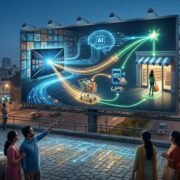
The most interesting change is therefore not the reallocation of a percentage of the budget from one channel to another. It is the development of a two-layer architecture.
The first layer is audience creation.
CTV can help brands build attention, familiarity and product understanding among defined audiences. Creative can remain emotionally engaging while media buying becomes more targeted.
The second layer is intent capture.
Retail media can intercept consumers closer to purchase, whether they are searching for a category, browsing products or actively considering a brand.
The two layers can also inform each other.
If CTV exposure generates an increase in branded search or product-page visits, retail environments can become a useful measurement layer. If retail data reveals that consumers respond strongly to a particular product benefit, that learning can influence future creative.
The media plan consequently becomes less linear.
Instead of moving from television to digital to retail as separate stages, marketers can build a feedback loop between them.
“The real opportunity lies in making awareness data and commerce data speak to each other.”
The Rise of Commerce Signals in Brand Planning
For years, FMCG media planning relied heavily on demographic information. Age, gender, location and household characteristics helped marketers determine where to place their messages.
Those signals remain useful, but behavioural and commerce signals are becoming increasingly important.
Consider a consumer who has recently searched for a category, watched content related to it and browsed products on a commerce platform. That consumer is different from someone who simply falls within the same age bracket.
The second person may be statistically relevant. The first person is demonstrating an active signal of intent.
Retail media gives marketers access to more of these signals, while CTV can provide a scaled environment in which brands can build relevance around them.
This does not mean every FMCG campaign needs to become hyper-targeted. Mass reach remains valuable, particularly for categories where household penetration and mental availability drive growth.
The more nuanced approach is to determine where mass communication is necessary and where behavioural signals can improve efficiency.
Creative Has to Change Too
A new media mix cannot work if creative remains designed for only one environment.
Traditional FMCG advertising often begins with a television commercial and then adapts that asset into digital formats. In a CTV-and-retail ecosystem, the creative system needs to be more connected to the consumer journey.
A CTV film may establish the problem and demonstrate the product. A shorter video could reinforce the same benefit closer to consideration. A retail placement might focus on the product’s strongest functional proposition, price, pack size or promotion.
The brand idea remains consistent, but the job of each creative expression changes.
This is particularly important because retail media operates in environments where consumers are already making decisions. A creative unit that works beautifully in an entertainment setting may not work when a consumer is comparing three similar products on a commerce platform.
In that environment, clarity can become more important than spectacle.
“The creative idea should remain recognisable across the journey, but the message has to understand the job of the moment.”
Measurement Moves From Channel Metrics to Business Signals
One of the biggest challenges for a rebuilt media mix is measurement.
CTV may be evaluated through reach, frequency, completed views, incremental reach and brand outcomes. Retail media brings metrics such as impressions, clicks, product-page visits, search behaviour and sales.
The problem begins when each channel reports success independently.
A campaign can show excellent CTV completion rates while retail media reports strong conversion, yet the organisation may still struggle to establish whether the two are connected.
This is where incrementality becomes increasingly important.
Marketers need to understand what would have happened without the campaign, rather than simply counting everything that happened after exposure. Depending on the data and measurement infrastructure available, this can involve controlled experiments, geographic comparisons, exposed-versus-unexposed analysis or other forms of lift measurement.
The objective is not to force every channel into a single metric. It is to create a measurement framework that reflects the different jobs performed by different media environments.
CTV may contribute to awareness and consideration. Retail media may contribute more directly to conversion. The combined question is whether the total system is generating incremental business value.
What This Means for Agencies
The shift also changes the role of the media agency.
Historically, television planning, digital performance and shopper marketing could exist as distinct specialist functions. As CTV and retail media become more connected, those boundaries become less useful.
Agencies increasingly need to understand audience data, commerce behaviour, creative effectiveness and measurement as parts of the same planning problem.
This does not necessarily mean every agency needs to become a retail media specialist or a data company. It means planning teams need to understand how signals move across the ecosystem.
A campaign brief may increasingly begin with a business question rather than a channel question.
Instead of asking, “How much should we spend on television?” the marketer may ask, “How do we increase consideration among households that are entering the category, and how do we convert that consideration into incremental sales?”
The answer could involve CTV, retail media, search, creators, social and physical retail working together.
The Data Question Cannot Be Ignored
There is another reason this shift matters: data ownership.
Retail platforms possess valuable first-party signals because they sit close to commerce. Streaming platforms possess viewing and audience signals. Brands have their own customer and transaction data.
The challenge is that these datasets do not automatically connect.
Privacy requirements, platform restrictions, identity fragmentation and data silos can make cross-channel measurement difficult. FMCG marketers therefore need to think carefully about data governance, consent and the types of measurement partnerships they build.
The future media mix will not simply be more data-driven. It will need to be better organised around permissioned, usable and commercially relevant data.
Why Legacy Brands May Have an Advantage
There is an interesting paradox in this transition.
The brands most exposed to disruption are also the ones with some of the strongest assets to work with.
Legacy FMCG brands often have decades of consumer recognition, distinctive brand assets, distribution networks and large libraries of creative learning. They do not need to invent brand meaning from scratch.
What they need is a media architecture that can carry that meaning into a fragmented consumer environment.
CTV can extend the storytelling tradition of television. Retail media can bring that brand closer to moments of consideration and purchase. Data can connect the two more intelligently.
The opportunity is therefore less about abandoning the old model than rebuilding its strongest parts for a different media landscape.
The Next Media Mix Will Be Designed Around Moments
For FMCG marketers, the most important shift may ultimately be conceptual.
Media planning has traditionally been organised around channels. Television, digital, outdoor, print, social, search and retail were treated as separate lines in a budget.
The consumer does not experience them that way.
They experience a series of moments: discovering a need, noticing a brand, watching a demonstration, searching for information, comparing alternatives, adding a product to a basket and making a purchase.
A modern FMCG media strategy has to connect those moments.
That does not mean every interaction needs to be tracked or every impression needs to lead directly to a sale. Brand building remains a long-term exercise, and consumers rarely move through a perfectly measurable funnel.
But the distance between brand communication and commerce is shrinking.
CTV and retail media sit at two important points within that new architecture. One can help brands earn attention and build meaning at scale. The other can help them become visible when consumer intent is closer to action.
“The future FMCG media plan may not be defined by how much goes into television, digital or retail. It may be defined by how intelligently those environments work together.”
For legacy brands, that is the real rebuild. The challenge is no longer simply finding the next channel to add to the media plan. It is creating a system in which storytelling, audience signals, commerce and measurement reinforce one another.
In a fragmented media economy, the brands that can connect those pieces will have a different kind of advantage: not necessarily more reach, but a clearer understanding of what that reach is supposed to do.
“`