














Affiliate Commerce Is Eating Sponsorship: How Amazon and Flipkart’s Creator Programs Are Rewriting Influencer Pay

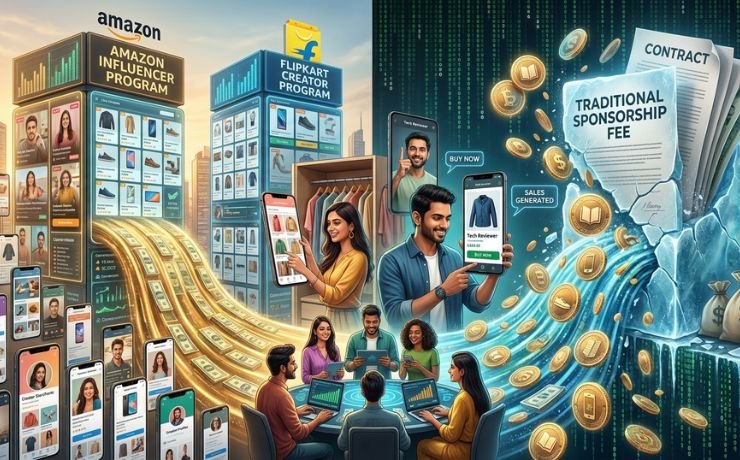
For most of the last decade, the economics of influencer marketing in India ran on a single, fairly blunt instrument: the flat fee. A brand wanted reach, a creator had an audience, and money changed hands somewhere in between an Instagram brief and a deliverable checklist. It didn’t matter, in any measurable sense, whether the audience actually bought anything. What mattered was impressions, engagement rate, and whether the creator’s aesthetic matched the brand’s mood board closely enough to survive a round of internal approvals. That model isn’t dead. But it is being quietly, systematically outcompeted by a mechanism that pays creators only when a transaction actually clears — and the two companies doing the most to accelerate that shift are Amazon and Flipkart.
This is worth sitting with, because it represents a genuine inversion of who bears the risk in influencer marketing. Under the old sponsorship model, the brand took the risk that the content wouldn’t convert, and paid regardless. Under the affiliate and creator-commerce model that Amazon and Flipkart have spent the last two years building out, the platform pays only for outcomes, and the creator absorbs the uncertainty of whether their audience actually clicks “buy.” That’s not a small shift in contract language. It’s a different theory of how influence should be priced.
The numbers behind the shift
Amazon India’s creator ecosystem — spanning the Influencer Program, Amazon Live, and Creator Central — has grown to roughly 1.25 lakh creators earning through the platform, up from about 1 lakh before the 2025 festive season, a 25% jump in a matter of months. In that same festive season, more than 40 lakh customers discovered products through creator content, with lifestyle, electronics, beauty and home categories showing the strongest traction, and creator-based discovery reaching over 2 crore shoppers across the year. These aren’t vanity metrics buried in a press release. They describe a functioning, at-scale commerce channel that runs in parallel to Amazon’s traditional search-and-browse funnel — one where a creator’s storefront, not a search query, is increasingly the first touchpoint in the purchase journey.
Flipkart’s version of this story has followed a messier but directionally similar arc. Its affiliate programme, historically simpler and lower-friction than Amazon’s — commissions ranging from roughly 2% to 15% against Amazon’s 1% to 9%, and a far lower minimum payout threshold — has increasingly routed new creator signups through intermediary networks rather than direct applications, a sign of a programme scaling faster than its own onboarding infrastructure can comfortably absorb. Both platforms have converged on the same underlying mechanic regardless: a personalised storefront, a trackable link, a commission that lands only when the link converts, and — critically — a bonus commission window for on-platform shoppable video that most creators didn’t have access to even two years ago.
Amazon’s own program economics make the shift explicit: onsite shoppable videos earn the base commission plus an additional bonus on any purchase made within 24 hours of the view. That’s not a sponsorship fee dressed up in new language. It’s a piece-rate wage for verified influence.
Why this is happening now, not five years ago
Affiliate marketing itself is nothing new — Amazon Associates has existed in some form since the late 1990s. What’s changed is the infrastructure sitting on top of it. Five years ago, a creator’s affiliate link was a slightly clunky bit.ly URL buried in an Instagram bio, disconnected from any native shopping experience, competing for attention with a dozen other links in the same bio. Today, that link routes to a full storefront hosted directly on Amazon or Flipkart’s own domain, populated with shoppable video, curated idea lists, and a UI indistinguishable from the retailer’s own merchandising pages. The creator isn’t sending traffic away from the platform to be converted elsewhere — they’re operating a mini storefront inside the platform’s own walls, with all the trust signals (reviews, delivery guarantees, return policies) of the parent marketplace intact.
That distinction matters enormously for conversion rates, and conversion rates are precisely what has made this model economically credible to brands and platforms alike. A recommendation that requires a shopper to leave Instagram, open a browser, and manually search for a product loses the overwhelming majority of its intent somewhere in that friction. A recommendation that drops a shopper directly into a checkout-ready product page, with the creator’s video still playing beside the buy button, converts at a dramatically higher rate — and that difference in conversion is the entire economic argument for why affiliate commerce can now out-earn flat-fee sponsorship for a growing share of creators.
The broader context helps explain why platforms are racing to build this infrastructure rather than treating it as a side feature. Global influencer marketing spend crossed $38.2 billion this year, up more than 17% year-on-year, and Amazon-affiliated creator content alone is estimated to account for over $4 billion of that figure. When a single retail platform’s creator ecosystem represents a meaningful double-digit-billion-dollar slice of the entire global influencer economy, it stops being a retention tactic and starts being a strategic business unit in its own right.
What this does to creator incentives
The behavioural shift this produces among creators is significant, and not always in ways brands anticipate. A creator paid a flat sponsorship fee has every incentive to make content that looks good and satisfies the brand’s brief — engagement and aesthetics are the currency that gets the next deal. A creator paid on commission has a completely different incentive: make content that actually gets someone to buy, in the next 24 hours, on this specific platform. That tends to produce content that looks less like a polished campaign film and more like an unglamorous, highly specific product demonstration — the kind of “does this actually work” video that performs poorly on brand safety mood boards but extremely well on conversion.
This is, in effect, quietly retraining a generation of Indian creators toward a discipline that used to belong almost exclusively to performance marketers: attribution literacy. Creators building meaningfully on Amazon’s or Flipkart’s affiliate infrastructure are learning, often through trial and error, which categories convert (electronics and beauty routinely outperform), which content formats drive same-session purchases versus considered ones, and how much of their income depends on being present at the exact moment a shopper is ready to transact rather than simply being visible in their feed. That’s a fundamentally different skill set from building an aesthetic, and it’s reshaping who succeeds in the middle tier of India’s creator economy — often favouring creators with smaller, high-intent audiences over creators with large, passive ones.
Where sponsorship still wins — and where it doesn’t
None of this means flat-fee sponsorship is being wholesale replaced. Brand awareness campaigns, category-defining launches, and top-of-funnel storytelling still benefit from the predictability of a guaranteed fee, and top-tier creators with genuine cultural cachet will continue to command those rates regardless of what any affiliate dashboard shows. What’s actually happening is more of a tiering effect: sponsorship increasingly concentrates at the very top of the creator pyramid, where reach and brand association are the product being purchased, while affiliate and commission-based commerce is eating into the vast, previously underpriced middle tier of creators — the ones with 10,000 to 500,000 followers who used to be paid inconsistent, often below-market flat fees, and who are now finding that a well-placed shoppable video during a festive sale can outearn a mediocre brand deal several times over.
This middle tier is also where Amazon Live has quietly become one of the more consequential formats. Livestream shopping — long a much-hyped, under-delivered category in markets outside China — has found real traction inside Amazon’s ecosystem specifically because it fuses the immediacy of live commerce with the trust infrastructure of an established marketplace. A brand streaming a product demo with a mid-tier creator, backed by real-time cart mechanics and a built-in audience already primed to buy, sidesteps the two biggest problems that killed earlier livestream shopping experiments elsewhere: discovery and trust. Brands running structured Live programs in 2026 are, by most industry accounts, building a compounding distribution advantage that most competitors have not yet begun to replicate.
What agencies and brands need to rethink
For agencies still structuring influencer budgets primarily around flat-fee deliverables, the practical implication is that measurement needs to catch up to the mechanism. A campaign brief that pays a creator regardless of sales performance, while a competitor’s affiliate-driven creator earns a variable, uncapped return on the exact same product category, is going to struggle to retain that creator’s best content over time — the incentive gradient simply points the other way. Brands should expect, and increasingly should design for, hybrid structures: a baseline fee that compensates for content production and usage rights, layered with a commission component that rewards actual conversion. This isn’t a radical idea in performance marketing generally; it’s simply arriving late to influencer marketing specifically, because influencer marketing spent its first decade optimising for reach rather than for revenue attribution.
The deeper story here is about who owns the customer relationship at the point of purchase. For years, brands worried about creators building parasocial relationships that competed with brand loyalty. What Amazon and Flipkart have effectively done is make the creator’s storefront a sanctioned extension of the retailer’s own funnel — which means the platform, not the brand, increasingly owns the last mile of that relationship. Brands get the conversion. Creators get paid for delivering it. And the retailer captures the data, the margin, and the growing share of discovery that used to belong to search and category browsing. Sponsorship isn’t disappearing from Indian influencer marketing. But the money is moving toward whoever can prove, transaction by transaction, that the audience they built actually buys — and for now, Amazon and Flipkart are the two platforms best positioned to do that proving.
