














India’s AdTech Funding Rebound: What a 138% Jump in H1 2026 Funding Signals After Last Year’s Slowdown

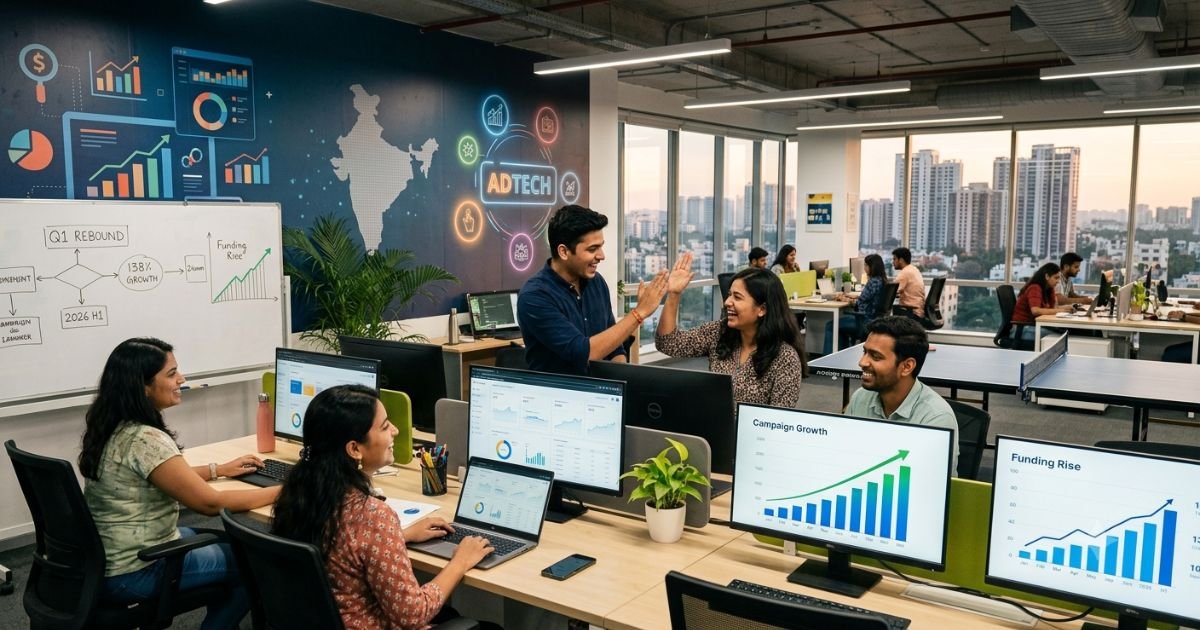
For the better part of eighteen months, India’s AdTech founders got used to a particular kind of silence. Term sheets that once arrived within weeks began taking quarters. Series B conversations quietly reframed themselves as “extended seed” conversations. Investors who had piled into programmatic, adtech infrastructure and creator-monetisation plays during the 2021 funding supercycle were, by 2024 and much of 2025, asking harder questions about unit economics, customer concentration and the defensibility of anything sitting between a brand’s media budget and a consumer’s screen. The mood wasn’t panic. It was something quieter and more corrosive: fatigue.
Which is what makes the numbers now coming out of H1 2026 so striking. According to Tracxn’s sector data, AdTech companies raised roughly $1.19 billion in equity funding across 29 rounds globally between January and June 2026, compared with about $498 million across 42 rounds in the same window last year — a jump of nearly 139%. Fewer deals, dramatically more capital. That single ratio tells you almost everything you need to know about where investor conviction has gone: not toward spreading small cheques across a wide field of early bets, but toward concentrated, high-confidence wagers on companies that have already proven they can survive a downturn.
India sits at an unusually interesting point on this map. It is home to 844 AdTech startups, the second-highest count of any country in the world after the United States’ 3,648, and ahead of the United Kingdom’s 745. Over the past decade, Indian AdTech companies have collectively raised close to $1 billion — a fraction of the $8.56 billion drawn by their American counterparts, but enough to make India the clear anchor of AdTech innovation outside the US and China. So when global AdTech capital swings back toward risk-on, India isn’t a footnote to that story. It’s one of the markets the story is actually about.
The shape of the slowdown, and why it mattered
To understand why a 138% jump feels less like an anomaly and more like a correction, it helps to remember what the slowdown actually looked like on the ground. It wasn’t that advertising stopped growing in India — quite the opposite. Digital ad spend kept climbing through 2024 and 2025, propelled by quick commerce, D2C brands and an explosion of regional-language content consumption. What dried up was investor appetite for the infrastructure layer sitting underneath that growth: the DSPs, the attribution platforms, the identity-resolution tools, the creator-monetisation rails.
Part of this was macro. Global venture capital, still working through the hangover of 2021’s excess, rewarded profitability and punished growth-at-all-costs. Part of it was AdTech-specific: privacy regulation, the slow unwinding of third-party cookies, and Google’s own oscillating stance on Chrome’s cookie deprecation timeline left investors genuinely unsure which technical bets would still matter in three years. And part of it, frankly, was India-specific — a market where AdTech companies have historically struggled to command the valuations of their SaaS or fintech peers, in part because so much of programmatic value still accrues to the platforms (Google, Meta, Amazon) rather than to the independent layer trying to sit alongside them.
The correction wasn’t a rejection of AdTech as a category. It was a rejection of AdTech companies that couldn’t explain, in one sentence, why a brand would pay them instead of just paying Google more.
That distinction — between rejecting a category and rejecting undifferentiated companies within it — is the key to reading this year’s rebound correctly. Capital didn’t return because investors suddenly fell back in love with programmatic. It returned because a specific cohort of companies spent the downturn building something that Google, Meta and Amazon structurally cannot offer: neutral, cross-platform measurement and AI-native optimisation for a media environment that no longer runs through a handful of predictable channels.
What’s actually pulling the capital back
Three forces are doing most of the work in this rebound, and all three show up clearly in the deal data.
The first is AI-native retooling. Across India’s broader startup ecosystem, AI funding surged more than fourfold year-on-year in H1 2026, and a meaningful slice of that capital flowed toward companies applying AI to advertising specifically — creative generation, fatigue detection, agentic media buying and automated bid optimisation. Investors who spent 2023 and 2024 asking “is this just a wrapper on GPT?” are now asking a more generous question: “does this company own a proprietary data loop that gets better with every campaign it runs?” AdTech companies, sitting on troves of first-party performance data, are unusually well positioned to answer yes.
The second is CTV and shoppable commerce. As streaming platforms in India — from JioHotstar to Amazon’s ad-supported tiers — mature into genuine ad inventory at scale, the measurement and targeting problem around connected TV has become urgent rather than theoretical. Companies solving CTV attribution, or stitching shoppable formats directly into streaming inventory, are attracting cheques not because CTV is fashionable but because brands are already spending real money there and need someone to prove it worked.
The third, and perhaps most India-specific, is the maturing of homegrown platform businesses that have quietly built durable revenue rather than chasing headline growth. Mobavenue AI, for instance, reported a 60% jump in quarterly profit after tax alongside 42% revenue growth earlier this year — the kind of unglamorous, compounding performance that doesn’t generate viral funding announcements but does generate investor confidence. Lemma has been expanding its sales bench across Mumbai, Delhi and Bengaluru. InMobi rolled out a new self-service programmatic buying hub for advertisers. None of these are the eye-catching mega-rounds that defined 2021. They’re the sound of a sector re-earning trust, one renewal at a time.
The concentration paradox
Here’s the part of the story that trade coverage tends to undersell: this rebound is also a story about fewer companies getting funded, not more. Across India’s tech ecosystem broadly, total funding rose 12% to $7.2 billion in H1 2026, even as the number of funding rounds fell a steep 43%, from 1,149 to 652. The top three rounds alone accounted for nearly a third of all capital raised in the half. AdTech’s own trajectory — fewer rounds, dramatically higher average size — mirrors this pattern almost exactly.
What this means in practice is that the rebound isn’t evenly distributed relief. It’s a filtering mechanism. Founders who spent the downturn building genuine differentiation — proprietary data assets, defensible AI models, real enterprise revenue — are being rewarded with larger cheques and faster diligence than they might have seen even in 2021. Founders who were building “another DSP” or “another attribution dashboard” without a clear wedge are finding the door just as closed as it was twelve months ago, arguably more so. Tracxn’s own framing of the broader Indian market — investors “trading breadth for depth” — applies with particular force to AdTech, a category that was arguably overcrowded to begin with, with over 2,500 funded companies globally chasing a market that ultimately funnels most of its value through three or four dominant platforms.
This is, in a sense, a healthier market than the one that existed in 2021. It’s also a considerably less forgiving one. The bar for a first cheque has risen; the bar for a follow-on round has risen further still. Agencies and brand marketers tracking which AdTech vendors to bet on for 2027 planning cycles would do well to treat funding announcements not as a signal of hype, but as a genuine proxy for staying power — because that, increasingly, is exactly what investors are pricing in.
What this signals for the marketing ecosystem
For agencies, brand marketers and media owners watching this from the outside, the practical implications are worth spelling out. First, expect consolidation to accelerate rather than slow. Ten acquisitions have already happened in the global AdTech sector in the first half of 2026 alone, and well-capitalised players — flush with fresh late-stage funding — are the natural acquirers of smaller, undifferentiated competitors that couldn’t raise this round. Vendor lists that agencies built five years ago are likely to shrink through attrition and M&A rather than through any deliberate rationalisation effort.
Second, expect the AdTech companies that did raise this year to move fast on product, because that’s precisely what investors are underwriting. A large Series C or D round in this environment isn’t growth capital in the old sense of “spend more on customer acquisition.” It’s product capital — a bet that the company can ship AI-native features quickly enough to stay ahead of both platform-native tools (Google’s own AI-driven Performance Max, Meta’s Advantage+) and a new wave of leaner, AI-first challengers. Brands working with funded AdTech partners should expect — and should ask for — a faster product roadmap in exchange for platform loyalty.
Third, and perhaps most importantly for India specifically, this rebound arrives at a moment when the broader Indian advertising market itself is undergoing structural change: the rise of regional and vernacular content, the shift of ad dollars toward CTV and retail media, and quick commerce’s transformation of the entire consumer funnel. AdTech capital returning now isn’t returning to fund the last cycle’s problems. It’s returning to fund infrastructure for a media landscape that looks meaningfully different from the one that existed when the last funding boom peaked in 2021 — more fragmented, more AI-mediated, and far more dependent on real-time, cross-channel measurement than anything the 2021 vintage of companies was built to solve.
The cautious read
None of this should be mistaken for a return to 2021-style exuberance, and the smarter operators in the space aren’t treating it that way. A 138% jump off a genuinely depressed base is a different animal from sustained, broad-based growth, and the deal count — still down from prior years even as dollar volume climbs — is the tell. What’s happening is narrower and, in some ways, more meaningful than a boom: a small set of companies that survived a real winnowing are now being handed the capital to define what AdTech looks like for the next five years, while everyone else in the category is left to either find a niche, get acquired, or fold quietly.
For India’s AdTech founders, the message of H1 2026 is unambiguous. The money is back, but it isn’t back for everyone, and it certainly isn’t back on the old terms. It’s back for companies that can point to a proprietary data advantage, a genuine AI moat, and — increasingly non-negotiable — a path to profitability that doesn’t depend on the next funding round arriving on schedule. That’s a narrower door than the one that existed five years ago. But for the founders who can walk through it, it may well be a sturdier one.
