













Unified Reach Planning: Deduplicating linear, CTV and mobile in a single plan

For years, media planning has been organised around channels. Television delivers mass reach, digital video offers targeting and measurement, and mobile advertising provides access to consumers throughout the day. Each channel has developed its own buying systems, audience metrics and reporting conventions. The difficulty begins when a brand wants all three to work together.
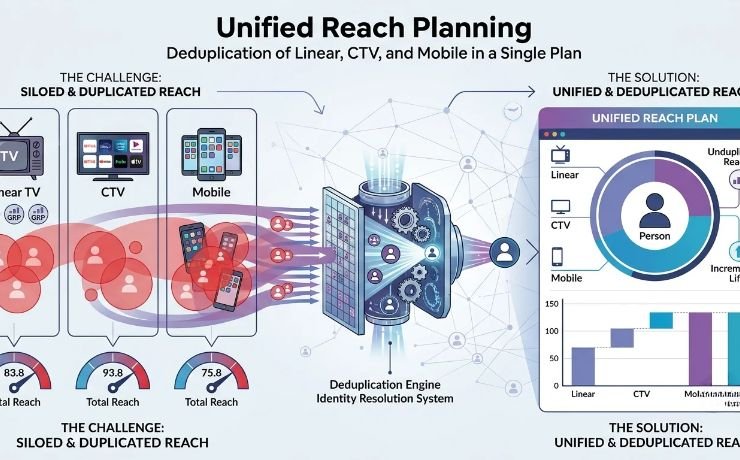
A consumer watching a television programme may also stream the same content on a connected TV, encounter a video advertisement on a mobile application and later see another campaign impression while browsing a website. Across separate media plans, each interaction can appear to represent a new person reached. In reality, the same individual may have been counted several times.
This is the problem unified reach planning seeks to solve. By bringing linear television, connected TV (CTV) and mobile into a more coordinated planning framework, advertisers can understand how much of their intended audience they are reaching, where duplication is occurring and whether additional spending is expanding coverage or simply repeating exposure.
The idea is straightforward. Its execution is not. Different platforms identify audiences differently, television measurement operates on a different basis from digital impression reporting, and privacy restrictions limit the ability to connect individual users across environments. For Indian advertisers operating across a rapidly changing video landscape, deduplicated reach is becoming a central question of media effectiveness rather than a technical refinement.
The cost of counting the same audience twice
Reach has traditionally been one of the principal measures of television advertising. It tells marketers how many people within a defined audience were exposed to a campaign, while frequency indicates how often those people encountered it. Together, the metrics help planners assess whether a campaign is reaching enough of its intended audience without exposing the same people excessively.
Digital video has added greater flexibility to this equation. Advertisers can select audience segments, adjust budgets in response to performance and evaluate delivery through platform-specific dashboards. Yet the additional detail can create a misleading sense of completeness when each platform measures its own audience independently.
Consider a hypothetical campaign aimed at urban adults aged 25 to 44. Linear television reaches a substantial portion of the target audience, while CTV extends the campaign into streaming environments. Mobile video adds further exposure through social platforms, publishers and applications.
Each channel reports a healthy reach figure. However, some viewers may have encountered the advertisement on all three. Without a method of accounting for this overlap, the combined reach figures cannot simply be added together to establish the campaign’s total audience.
The consequence is more than a reporting discrepancy. If planners overestimate the number of unique people reached, they may allocate too much budget to audiences that have already seen the campaign while underinvesting in those who remain unreached.
Duplication can also distort frequency. A consumer exposed repeatedly across television, CTV and mobile may experience a much heavier advertising load than any individual platform report suggests. At the same time, another consumer may receive little or no exposure.
For brands, the objective is not to eliminate repetition altogether. Repeated exposure can support awareness, recall and consideration. The objective is to make repetition intentional, ensuring that frequency contributes to the campaign’s purpose rather than emerging accidentally from disconnected buying decisions.
Why linear television, CTV and mobile are difficult to combine
Although all three channels can deliver video advertising, they do not operate on identical foundations.
Linear television is generally planned using television audience measurement, programme ratings and demographic estimates. These systems help advertisers understand audience delivery across channels and time slots. Measurement typically reflects audience behaviour at a household or panel-based level, depending on the system and methodology involved.
CTV operates through internet-connected television devices and streaming applications. Its advertising inventory may be purchased directly from streaming services or through programmatic platforms. Reporting can include impression-level delivery, device information and platform-specific audience signals, subject to the data available and the relevant measurement arrangements.
Mobile introduces another set of variables. Video advertisements may appear within social feeds, publisher applications, mobile websites and other digital environments. Each platform may use its own account, device, event or audience identifiers, and the availability of those signals depends on the environment and privacy permissions.
These differences make direct comparison difficult. A television rating point is not the same unit as a digital impression, and a device is not necessarily equivalent to an individual viewer. One household may contain several people, while one person may use multiple devices. A connected television may be shared by an entire family, whereas a mobile phone is more likely, though not guaranteed, to be used by one person at a time.
Even when the same consumer is reached across channels, the available data may not establish that connection. A television measurement system may estimate audience exposure without identifying a specific individual, while a digital platform may report an impression against its own account or device identifier.
Unified planning must therefore do more than place three reports in a single spreadsheet. It needs a defensible methodology for estimating audience overlap, reconciling differences in measurement and explaining the uncertainty that remains.
Deduplication begins with a common definition of reach
Before attempting to combine channels, advertisers need to agree on what they mean by a unique person reached. This sounds obvious, but it is one of the most important decisions in cross-media planning.
Is the campaign measuring people within a particular age group, households, devices or platform-defined audiences? Does reach mean exposure to at least one advertisement, or does it require a minimum level of viewability or video completion? What time period is being measured? Are all channels using the same geographic and demographic definitions?
Without agreement on these questions, two reports can produce different numbers while appearing to describe the same outcome.
A unified plan establishes a common target audience, a consistent campaign window and a clear definition of exposure. It then assesses the overlap between linear television, CTV and mobile using the strongest available evidence.
Where privacy-compliant person-level matching is available, participating measurement partners may use agreed identifiers or controlled data environments to estimate overlap. In other situations, statistical modelling, audience panels or calibrated reach curves may provide estimates of cross-platform duplication.
Each method has limitations. Deterministic matching can provide a stronger basis for linking records when suitable identifiers and permissions exist, but it cannot account for every viewer or device. Probabilistic methods estimate relationships using patterns and assumptions, making their reliability dependent on the quality of the underlying data and the model.
These differences should be visible in reporting. A deduplicated reach figure is not automatically a direct count of every unique individual. It may be an estimate produced by combining observed exposure data with a model of audience overlap.
For marketers, understanding how the number was produced is as important as receiving the number itself.
How a unified plan changes media allocation
Once overlap becomes visible, the role of each channel can be reconsidered. Rather than treating linear television, CTV and mobile as separate pools of reach, planners can evaluate how each contributes to the overall audience strategy.
Linear television may remain the principal vehicle for delivering broad reach quickly, particularly for campaigns targeting large audiences. CTV can add access to streaming viewers and offer more flexible buying opportunities. Mobile can extend exposure into digital environments where consumers discover content, interact with brands and spend time between television viewing occasions.
The value of each channel depends on the audience and campaign objective. A plan designed to maximise awareness among a broad national audience will look different from one aimed at younger urban consumers or a specific market segment.
Deduplication helps identify whether an additional investment is expanding unique reach or primarily increasing frequency among people already exposed elsewhere. If CTV is reaching viewers who are difficult to reach through linear television, it may provide valuable incremental coverage. If a mobile campaign repeatedly reaches an audience already exposed across television and CTV, its incremental contribution may be smaller than its standalone report suggests.
However, incremental reach should not become the only measure of value. Mobile exposure may encourage a search, generate a product-page visit or bring a consumer closer to conversion. CTV may provide a larger-screen storytelling environment that supports brand consideration. Linear television may deliver the scale needed to establish awareness.
The planner’s responsibility is to assess unique reach alongside the role each channel plays in the consumer journey. A channel that contributes less incremental reach may still have a useful function if it delivers meaningful engagement or supports a different campaign objective.
The goal is to allocate money according to the combined contribution of the channels, rather than allowing each platform’s individual performance report to determine the budget independently.
India’s viewing habits make cross-media planning more relevant
India’s video consumption landscape has become increasingly fragmented. Linear television continues to serve large audiences across entertainment, news, sports and regional programming. Streaming services have expanded the range of content available on connected televisions and mobile devices, while short-form video and social platforms have become significant destinations for digital attention.
For advertisers, this means the same broad audience can be distributed across different viewing environments. A consumer may watch a cricket match on television, stream a series through a connected television application and encounter short-form videos on a smartphone throughout the day.
The extent of this overlap varies by age, location, language, content preference and access to devices. It should not be assumed that all CTV viewers are unreachable through linear television, or that mobile video necessarily delivers a younger audience. Such assumptions require evidence at the level of the campaign and target audience.
Regional differences are equally important. Viewing patterns in metropolitan markets may differ from those in smaller cities and towns, while language preferences and programme choices can shape how audiences divide their time between platforms.
A national campaign that combines television, CTV and mobile without considering these variations may overinvest in already well-covered segments while missing opportunities elsewhere. Cross-media measurement can help reveal those gaps, provided its data and modelling are sufficiently representative of the audiences being targeted.
For Indian agencies, the opportunity lies in using unified planning to make media investments more responsive to actual viewing behaviour. This means moving beyond channel-level reach forecasts towards an understanding of how audiences move between screens and how those movements affect campaign delivery.
The identity question: who is the person behind the screen?
One of the biggest obstacles to deduplicated reach is identity. Platforms have different ways of recognising users, and those identifiers are not universally available or interchangeable.
A streaming application may have account-level information, a mobile platform may rely on logged-in users or device-related signals, and linear television measurement may use audience estimates derived from panels and household data. Combining these sources requires rules governing what information can be used, how records can be matched and how uncertainty should be managed.
Privacy considerations place additional limits on the process. India’s Digital Personal Data Protection framework and applicable rules make responsible data handling an important consideration for businesses working with personal data. Cross-media measurement should be designed around appropriate permissions, lawful processing, data minimisation and clearly defined responsibilities.
Not every planning exercise requires personally identifiable information. Depending on the methodology, aggregated reporting, privacy-preserving matching and controlled measurement environments may help estimate overlap without giving advertisers unrestricted access to individual-level records.
But privacy-safe measurement should not be treated as a guarantee of accuracy. A system can protect personal information while still producing incomplete or biased estimates if its underlying data does not represent the audience adequately.
Advertisers should therefore evaluate both dimensions: whether the approach handles data responsibly and whether the resulting estimates are sufficiently reliable for the decisions being made.
Measurement partnerships matter more than a single dashboard
The technology required for unified reach planning is rarely contained within one platform. Television measurement providers, streaming services, publishers, advertising platforms, agencies and independent measurement partners may each hold part of the information needed to estimate cross-media exposure.
This makes interoperability a practical concern. Different systems must agree on campaign definitions, reporting periods, audience parameters and the treatment of missing data. If one partner reports exposure at the device level while another reports estimated people, the differences must be reconciled before the numbers are combined.
Advertisers should also understand whether the measurement provider has access to sufficient data across all relevant channels. A system that sees only selected publishers or platforms may provide a useful view of part of the campaign, but it cannot automatically claim to represent total cross-media reach.
Independent measurement can help establish confidence, particularly when the same platforms being evaluated also provide their own performance reports. The objective is not to assume that platform data is inaccurate, but to create a consistent basis for comparison and accountability.
Agencies can support this process by documenting the methodology, explaining its limitations and ensuring that media plans are built around metrics that can realistically be measured. Where a reliable deduplicated figure is unavailable, it is better to report separate channel results alongside an explicit limitation than to present an unsupported combined total.
Frequency management is the other half of the equation
Deduplicated reach tells advertisers how many unique people a campaign may have reached. Frequency management addresses how often those people are exposed. The two measures need to be considered together.
A campaign may achieve strong unique reach but still expose a subset of viewers excessively. Conversely, strict frequency limits can reduce repeated exposure but may also constrain the campaign’s ability to build awareness among people who have seen the advertisement only once.
In a unified plan, frequency decisions should reflect the intended communication outcome. A product launch may require repeated exposure over a defined period, while a campaign focused on broad awareness may prioritise extending coverage to additional consumers.
Cross-platform frequency management is difficult when channels cannot recognise the same individual consistently. A limit applied within one digital platform may not account for impressions delivered through another platform or through linear television. Even where identity matching is available, the plan may not have complete visibility into every exposure.
For this reason, advertisers should distinguish between platform-level frequency caps and a genuinely coordinated cross-media frequency strategy. The former can control repetition within individual systems. The latter requires a broader understanding of exposure across channels, along with clear acknowledgement of what cannot be observed.
What marketers should demand from their agencies
Unified reach planning should begin before media buying, not appear as a retrospective reporting exercise. Agencies should establish the campaign’s audience, reach objectives, frequency expectations and measurement approach at the planning stage.
They should explain how overlap will be estimated, which partners will contribute data and whether the methodology supports a combined view of linear television, CTV and mobile. They should also disclose important limitations, including gaps in platform coverage, differences in audience definitions and reliance on modelled estimates.
During the campaign, performance data should inform adjustments where the available evidence supports them. If a channel is generating substantial duplication without sufficient incremental value, planners can consider shifting spend. If another channel is reaching underrepresented audience segments, increasing its allocation may improve the plan.
These decisions should not be based on a single metric. Cost per incremental person reached, total reach, frequency, audience quality and campaign outcomes can provide a more complete picture when interpreted together.
After the campaign, reporting should explain what was achieved against the original plan. Marketers should be able to see the estimated unique audience, the contribution of each channel, the extent of overlap where measurable and the implications for future investment.
From channel planning to audience planning
The real significance of unified reach planning is not that it combines three channels into one report. It changes the starting point of media strategy.
Instead of asking how much money should go to television, CTV and mobile independently, marketers can begin with the audience they need to reach and the role each environment can play in doing so. The question becomes how to distribute exposure across screens in a way that expands coverage, manages repetition and supports the campaign’s business objective.
That shift requires better data, compatible measurement systems and greater transparency about the assumptions behind cross-media estimates. It also requires marketers to accept that deduplication is not always an exact count, particularly when the available systems observe audiences in different ways.
As India’s video market continues to diversify, the ability to understand audience overlap will become increasingly important to the way advertisers evaluate media efficiency. The brands that benefit most will be those that use cross-media measurement to make informed decisions, rather than treating a combined reach figure as an end in itself.
Linear television, CTV and mobile each offer distinct strengths. The challenge is not to make them identical, but to understand how they work together. A unified plan can help advertisers see beyond separate dashboards and focus on the people behind the impressions.
Ultimately, better reach planning is about making every exposure count towards a deliberate strategy. The measure of success is not how many impressions a campaign can accumulate across screens, but how effectively it reaches the right people, at the right frequency, with the least avoidable duplication.
