











The Festive 2025 Playbook Brands Are Repeating for Diwali 2026

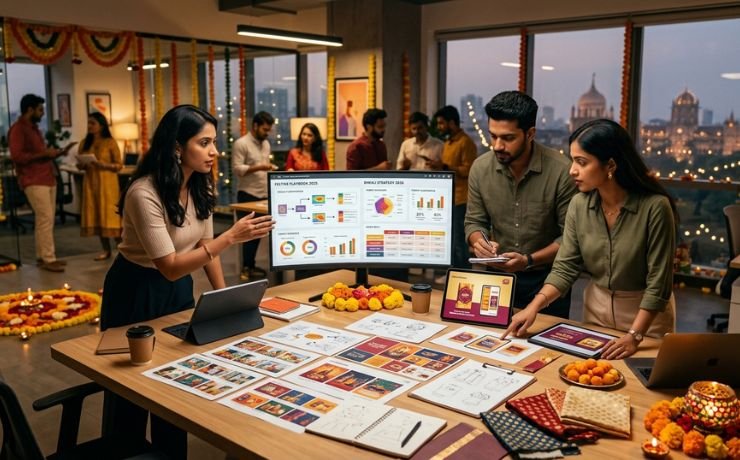
Every October, for roughly six weeks, India’s advertising industry stops being an industry and becomes something closer to a national mood board. Diwali is the one campaign season every marketer plans a full year around, the one moment when discount codes are expected to arrive wrapped in nostalgia, and the one window where a brand’s entire emotional positioning for the next twelve months gets compressed into a ninety-second film. By the time the diyas were lit in 2025, the playbook had crystallised into something remarkably consistent across categories — and if the early planning conversations already underway for Diwali 2026 are any indication, that playbook isn’t being torn up. It’s being refined.
What makes this worth examining now, months ahead of the next festive push, is that the 2025 season didn’t just produce a handful of memorable films. It produced a template — one built on emotional storytelling over discount messaging, hyper-early activation, cross-format omnipresence, and an unmistakable layer of AI-driven personalisation sitting underneath almost everything. Understanding why that template worked is the fastest way for any brand or agency to know exactly where to place its bets for Diwali 2026.
The discount has quietly become the subplot
The most striking shift to observe across the 2025 festive slate is how thoroughly the hard sell has receded into the background. A decade ago, festive advertising in India was built almost entirely around price — the loudest offer won the loudest share of voice. That formula has been steadily replaced by one built on emotional connection, and 2025 pushed that shift about as far as it has gone. Brands have increasingly realised that winning hearts matters more than pushing products, with digital platforms accelerating that transformation by giving marketers tools to build interactive and personalised campaigns.
The clearest expression of this came from categories that would traditionally have leaned hardest on discounting. Even e-commerce and marketplace players, whose entire business model is built on the sale event, chose narrative over price in their hero films. Flipkart’s festive campaign, built around the idea of giving India’s most stubborn old possessions a dramatic send-off, framed the sale less as a transaction and more as a ritual of renewal. Jewellery, home décor, FMCG and fintech brands followed the same instinct, each finding a version of the same emotional core — togetherness, homecoming, and the quiet dignity of small gestures — and building the offer architecture around it rather than in front of it.
Jewellery in particular leaned into legacy storytelling at scale, and the category’s overall ad volumes reflect just how central Diwali has become to its annual calendar. Jewellery ad volumes for the August–September 2025 period grew 130% over 2023 levels and 93% over 2024, according to TAM Media Research. That is not a marginal increase in festive spend. It is a category treating Diwali as its single most important commercial and brand-building event of the year, and building creative budgets to match.
Starting earlier, staying longer
The second pillar of the 2025 playbook was timing, and it is arguably the one Diwali 2026 planning will inherit most directly. Where festive activation once began a fortnight before the actual dates, brands have pulled that window forward by months. Leading brands launched their 2025 Diwali campaigns two to three months in advance, an early start designed to build brand recall, capture early-bird shoppers, and sustain a narrative arc all the way through to the peak festive week.
This extended runway changes the creative math considerably. A single hero film can no longer carry an entire season; instead, brands are building a staged narrative — a teaser or “arrival” moment weeks out, a mid-funnel push built around gifting and shopping utility, and a final week of high-frequency, conversion-oriented creative once Dhanteras and the core Diwali days arrive. For 2026, agencies that treat the festive campaign as a single asset rather than a phased release will already be behind brands that learned this lesson in 2025.
Everywhere, all at once
If timing was the second pillar, channel omnipresence was the third. The Indian festive consumer of 2025 was, by any reasonable definition, unreachable through a single medium. Consumers now move through a fluid ecosystem of digital and physical touchpoints, and a successful campaign has to be present everywhere they are — spanning YouTube, Connected TV, podcasts, and the fast-growing social commerce layer of Instagram.
What is notable is how deliberately brands sequenced these channels rather than simply spreading budget thin across all of them. Television and CTV carried the emotional hero films, built for sustained attention and high production value. Social platforms carried shorter cutdowns engineered for shareability, often built around a single hook line or musical motif that could survive being stripped of context. And influencer and creator partnerships — a category that saw a meaningfully higher share of festive budget in 2025 than in prior years — carried the participatory layer, inviting audiences to co-create rather than simply consume.
That participatory instinct showed up most clearly in the campaigns that travelled furthest on social media. Among the defining trends of viral Diwali 2025 content were emotional narratives rooted in Indian culture and family ties, with a number of campaigns built around reunions across distance, capturing the longing and joy of loved ones meeting again. The lesson for 2026 planning is explicit rather than implied: campaigns built for shareability, not just visibility, structurally outperform campaigns designed only to be seen.
The quiet infrastructure underneath the warmth
Beneath all of this emotional storytelling sat a layer of technology that most consumers never consciously registered, and that is precisely the point. The festive campaigns that resonated most in 2025 didn’t feel automated — they felt handcrafted. But increasingly, the creative variation that made a single campaign feel locally relevant across dozens of markets and languages was being generated and optimised algorithmically. A defining trend of the 2025 season was the use of dynamic creative optimisation, where AI algorithms tailor ad creatives in real time based on user data and context to maximise relevance and efficiency.
This is where the festive playbook and the broader industry conversation about AI-native marketing start to converge. Brands used dynamic creative tools to swap language, regional imagery, and even product framing depending on who was watching and where — all while keeping the emotional core of the campaign, the actual reason it resonated, untouched by automation. The lesson for 2026 is a calibration one: AI earns its place in the execution layer of festive creative, scaling a strong idea across geographies and formats, but the idea itself — the insight that makes a campaign feel true rather than templated — still has to come from a human read of what the season actually means to people.
Influencer marketing spend told a similar story of measured, data-informed scaling rather than blind expansion. Diwali remains the single biggest influencer marketing season of the year, with a reported 42% of brands increasing their spending specifically to capture festive audience attention. That figure is worth sitting with for a moment, because it signals something structural rather than seasonal: creator partnerships are no longer a supplementary festive tactic sitting alongside the hero film. For a growing share of brands, they are becoming the primary distribution mechanism for festive storytelling, with the traditional ad film increasingly functioning as source material that creators then adapt, react to, and extend.
Purpose as a differentiator, not a footnote
The fourth thread running through the strongest 2025 campaigns was a willingness to attach the brand to something beyond the transaction entirely — sustainability, local craft, community welfare — without letting that purpose overshadow the festive warmth the season demands. A defining trend saw brands incorporating social or environmental purpose into their Diwali work, encouraging sustainable celebration through fewer firecrackers or eco-friendly décor, and tying campaigns to local causes such as artisan and small-vendor support.
This is a delicate needle to thread, and 2025 offered plenty of evidence that it can go wrong when purpose is bolted onto a campaign as an afterthought rather than built into its premise. The campaigns that succeeded treated purpose as a narrative device rather than a disclaimer — a way of making the festive story feel more grounded in a real community, rather than a corporate checkbox appended to an otherwise conventional gifting film. For 2026, the brands most likely to repeat this success will be the ones that identify a genuine, specific cause adjacent to their category, rather than reaching for a generic sustainability message that could belong to any brand in any sector.
What repeats, and what needs to evolve
The risk inherent in any successful playbook is that it curdles into formula precisely because it worked. Industry observers were already flagging this concern before the 2025 season had fully played out, noting that festive advertising had come dangerously close to becoming predictable by 2024, rescued largely by a handful of campaigns willing to break tone — humour, absurdity, and honesty standing out precisely because everything around them had converged on the same wistful, string-laden nostalgia.
That tension will define Diwali 2026 planning more than any single tactic will. The structural elements of the 2025 playbook — early activation, emotionally-led storytelling, phased omnichannel distribution, AI-assisted personalisation at scale, and purpose woven authentically into the narrative — are sound enough to repeat, and most agencies briefing clients for 2026 are already building around them. But the creative expression sitting on top of that structure cannot simply repeat what worked last year, because the Indian festive consumer has now sat through several consecutive seasons of homecoming films, handwritten-card nostalgia, and family-reunion narratives, and the marginal emotional impact of the fourth or fifth iteration of that same story is measurably lower than the first.
The brands best positioned for Diwali 2026, in other words, are the ones treating last year’s playbook as infrastructure rather than script — keeping the proven mechanics of timing, channel sequencing, and personalisation firmly in place, while insisting that the creative idea riding on top of that infrastructure earns its place in a crowded, increasingly discerning festive feed. The formula that worked in 2025 will keep working in 2026 only for as long as it doesn’t feel like a formula. That is the real brief every agency should be writing against right now, months before a single diya is lit.
